
Report
December 2025
The AI Enablement Journey
Drawing on insights from Factor’s 2025 ANZ CFO, CIO and Data & AI leader surveys, it explores how organisations are moving from fragmented, legacy architectures to unified, composable, and AI-ready platforms.

85%
At the same time, digital adoption and artificial intelligence are reshaping the rules of engagement: Factor's retail re
46%
Consumer behaviour also evolved: Factor's research found that nearly half of shoppers (46%) reduced their spending and 1
2.1%
After a sluggish 2024, Australia's economy has grown about 2.1% this year, supported by easing inflation, gradual intere
3%
Reserve Bank of Australia's August 2025 statement notes that growth among Australia's major trading partners is likely t
Retail in Australia and New Zealand is at an inflection point. After a turbulent 2024, characterised by sticky inflation, elevated interest rates and subdued consumer confidence, the sector has been preparing for renewed growth from mid-2025 as economic conditions ease. At the same time, digital adoption and artificial intelligence are reshaping the rules of engagement: Factor's retail research finds that 85% of consumers switch regularly between in-store and online channels, and 40% of Australian shoppers are omni-channel, favouring online shopping for competitive pricing and delivery speed.
These structural shifts create both urgency and opportunity. Legacy enterprise resource planning (ERP) platforms, often 15-20 years old, cannot deliver the real-time data, seamless customer experiences and unified governance needed for AI co-pilots and agentic intelligence. Factor's surveys of CFOs, data-and-AI leaders and CIO/CTO respondents reveal common pain points: fragmented data, manual processes, skills gaps and limited integration maturity. Yet they also reveal appetite for change, with finance and technology leaders ranking AI enablement, data quality and co-pilot use cases among their highest priorities. The journey to an AI-first retail core therefore demands a strategic framework: modernising foundational systems while delivering incremental value through finance co-pilots, demand planning and real-time margin control.
A turbulent 2024 and cautious optimism for 2025-2026
GDP growth should pick up gradually as anticipated rate cuts feed through, so retailers must continue to prioritise margin management, operational efficiency and disciplined investment.
In 2024 inflation remained sticky and interest rates stayed high, prompting many consumers to tighten their spending. Factor Research notes that this led to a stalled recovery in the second quarter of 2024, compelling retailers to scrutinise operations and optimise costs. Concurrently, the Australian government's sustainability reporting framework came into force on 1 January 2024: large businesses with revenue above AU$500 million must now disclose climate risks and ESG metrics, with the framework extending to companies above AU$200 million and AU$50 million over the next three years. Consumer behaviour also evolved: Factor's research found that nearly half of shoppers (46%) reduced their spending and 14% traded down to private-label products, while social commerce surged, particularly among Gen Z.
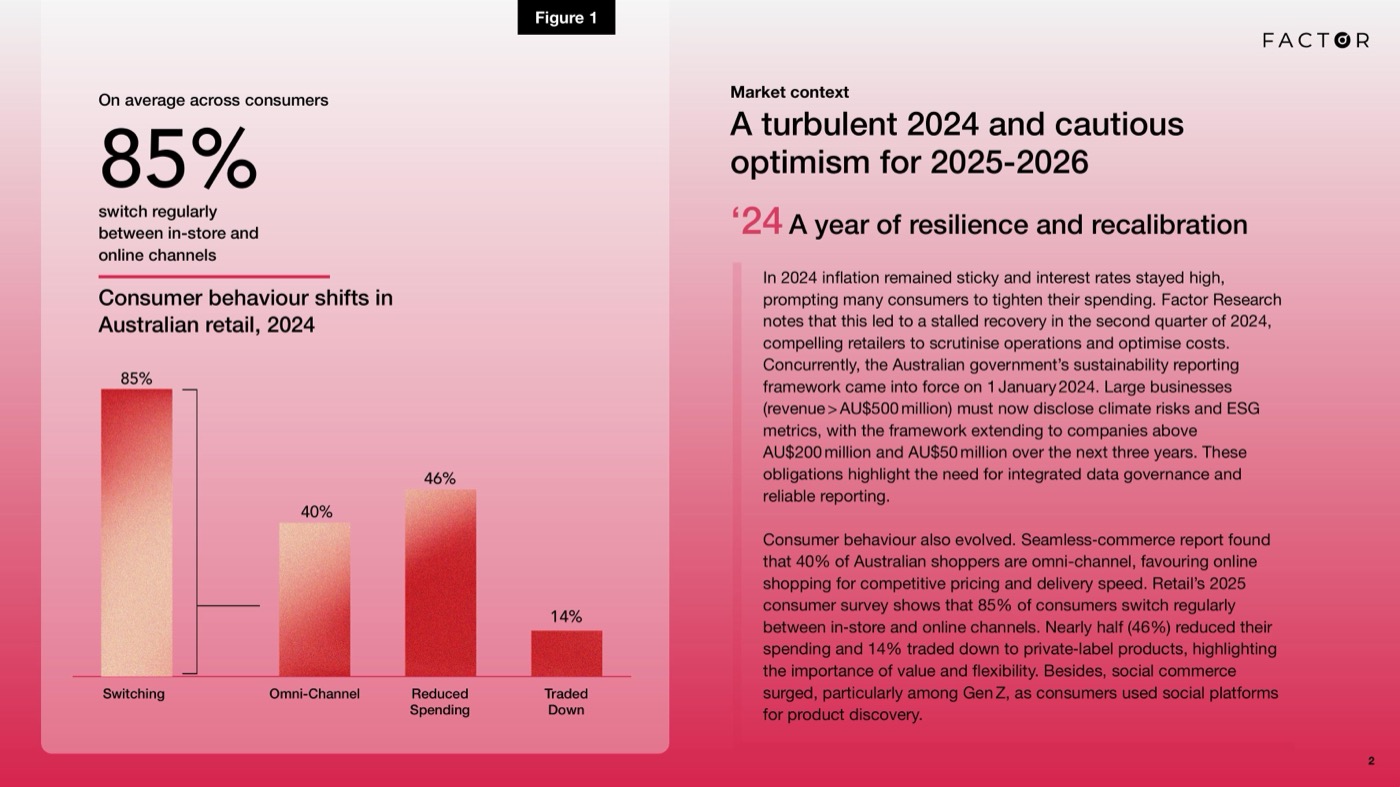
Figure 1: Consumer behaviour shifts in Australian retail, 2024. 85% switch regularly between in-store and online channels.
The Australian Retail Outlook 2025 has proven broadly accurate in its cautiously optimistic forecasts. After a sluggish 2024, Australia's economy has grown about 2.1% this year, supported by easing inflation, gradual interest-rate relief and improving consumer confidence. Discretionary categories have rebounded and retailers have accelerated technology investment. Cost-of-living pressures still shape household behaviour, but real household incomes have improved, inflation sits within the Reserve Bank of Australia's target range, and the savings rate has normalised, sitting above 5% after having dropped below 2% during the crisis.
2.1%
growth in Australia's economy this year, supported by easing inflation and gradual interest-rate relief
6%
higher spending on electronics and home furnishings
10%
further climb in health-and-wellness outlays, on top of the 8.8% rise in 2024
15%
rise in hybrid (online plus in-store) shopping behaviour
40%
of all purchases now influenced by AI recommendations
12%
trimmed from logistics costs through autonomous delivery and hyper-local fulfilment
2026 and beyond: structural shifts and technology acceleration
Looking beyond 2025, the macro environment is expected to stabilise rather than boom. The Reserve Bank of Australia's August 2025 statement notes that growth among Australia's major trading partners is likely to slow into 2026 as higher tariffs and global policy uncertainty take effect, while underlying inflation is expected to stay near the midpoint of the 2-3% target. GDP growth should pick up gradually as anticipated rate cuts feed through, so retailers must continue to prioritise margin management, operational efficiency and disciplined investment.
These conditions heighten the importance of technological acceleration. Industry analysts forecast that by 2026, AI analytics will evolve from simple automation toward "enterprise aware" augmentation, enabling natural language queries across disparate data sets for non-technical users. Retail media networks are expected to become sophisticated ecosystems that leverage transaction data for hyper-personalised marketing, while AI-enabled supply chain and computer vision systems will enhance forecasting accuracy, detect loss and automate workforce scheduling. To capitalise, retailers must invest in data architectures and modular, cloud-native platforms that can scale to support the next generation of co-pilots and agentic AI.
What finance leaders told Factor
Factor's insights draw on leaders across IT, finance, data, operations and technology in Australia and New Zealand's retail landscape, from apparel and luxury to food, beverage and consumer goods. Finance leaders are grappling with ageing systems, manual processes and fragmented data, and many CFOs described the desire for automation, better cashflow visibility and more time for business partnering. The priorities they reported to Factor for the next 12 months fall into three broad categories. About one third selected revenue growth and profitability as their principal objective. Roughly 27% prioritised cost reduction and operational efficiency: streamlining workflows and eliminating manual tasks. Just under a quarter cited upskilling and retaining finance talent. Nearly half of respondents emphasised digital transformation milestones, such as completing ERP rollouts or modernising core platforms.
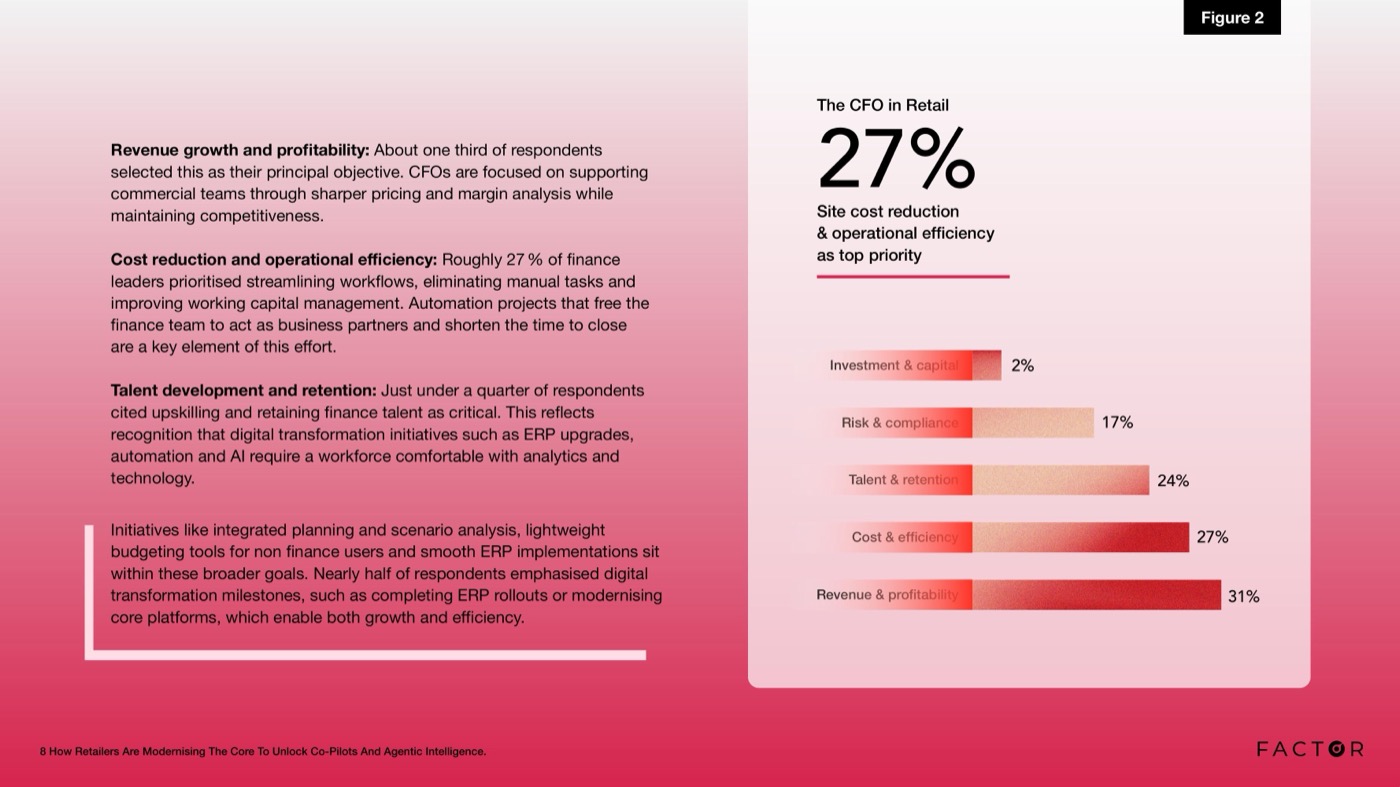
Figure 2: CFO priorities in retail. Revenue and profitability leads at 31%, ahead of cost and efficiency (27%) and talent and retention (24%).
The operational picture explains the urgency. When CFOs described their most persistent friction areas to Factor, budget constraints topped the list at 20% of responses, followed by data fragmentation at 14%, disconnected planning at 12%, manual processes and ROI visibility at 10% each, and ownership and accountability gaps at 6%. Addressing them requires unified platforms, data governance and automation to enable responsive, insight-led decision-making.
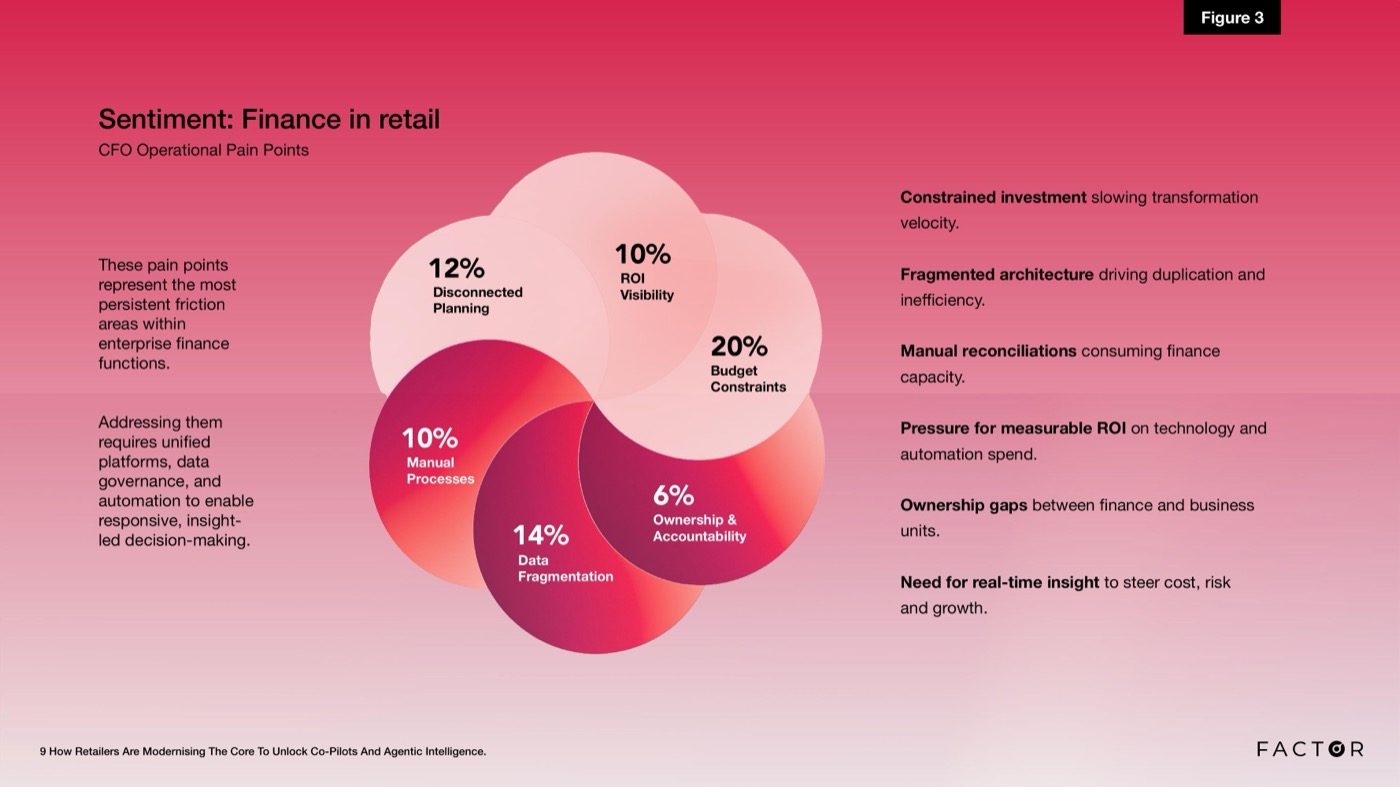
Figure 3: CFO operational pain points, led by budget constraints (20%) and data fragmentation (14%).
The data leader: between fragmentation and ambition
Data leaders across ANZ retail are explicit about both their stumbling blocks and their aspirations. In Factor's survey, the biggest obstacles are data silos and integration gaps (around 20% of responses) and budget constraints and cost pressures (about 18%). Complexity of data management came next at 15%, while skills and talent shortages were highlighted by roughly 13% of respondents. Smaller proportions cited regulatory and compliance constraints, difficulty proving ROI, and translating technical benefits into business value (each around 10%), with low data quality and lack of observability mentioned by about 5%. The picture that emerges is of data and AI programmes hampered by fragmentation, tight budgets and a lack of skilled people.
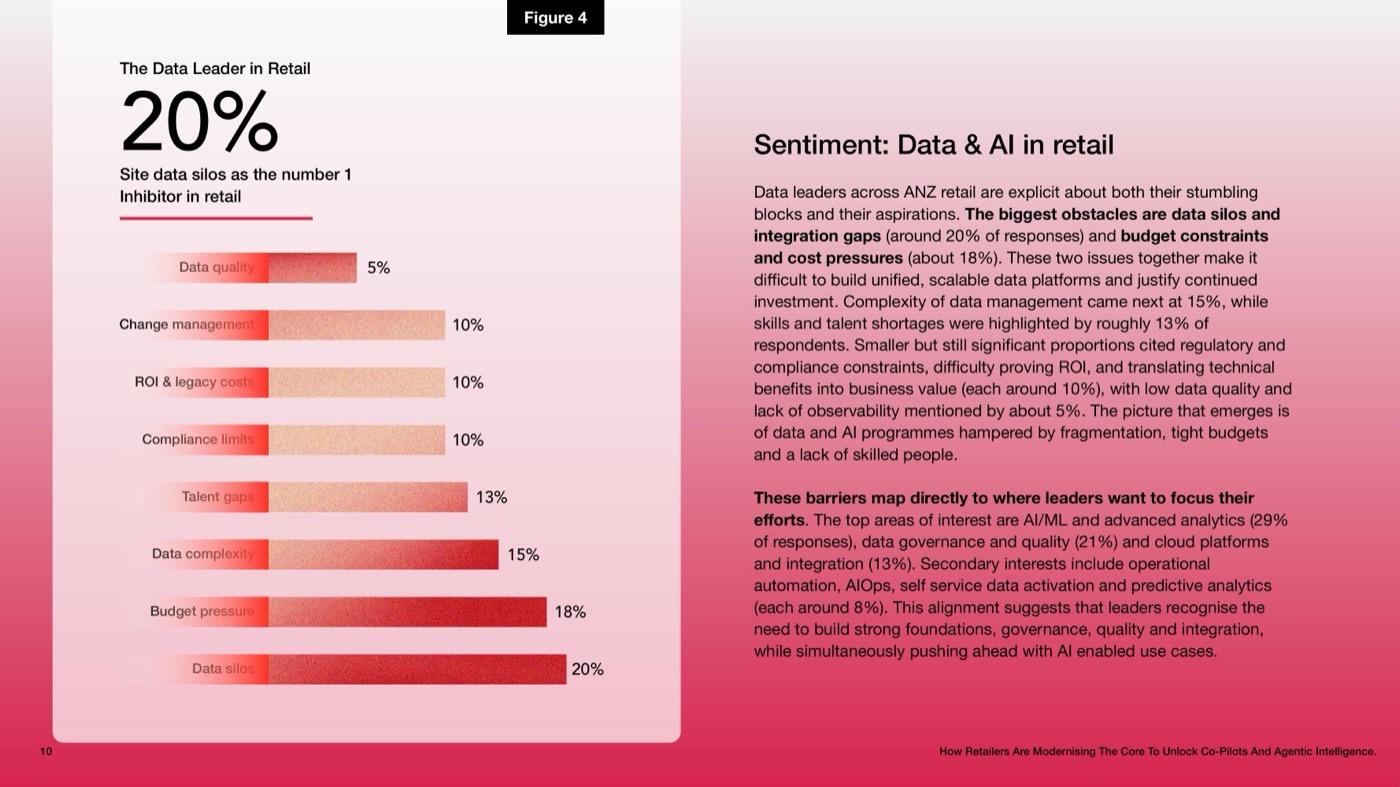
Figure 4: The data leader in retail. Data silos are the number one inhibitor at 20%, followed by budget pressure (18%) and data complexity (15%).
These barriers map directly to where leaders want to focus their efforts. The top areas of interest reported to Factor are AI/ML and advanced analytics (29% of responses), data governance and quality (21%) and cloud platforms and integration (13%), with operational automation, AIOps, self-service data activation and predictive analytics each around 8%. Maturity remains uneven: roughly 29% of organisations describe themselves as data aware (using data regularly but not exclusively), another 29% are at an early stage or unsure, and just over one fifth each are data driven or data adjacent. Factor Research analysis based on the CIO Survey (N = 305) finds that high-performing retailers are twice as likely to operate with data-driven foundations.
3 in 4
data leaders are prioritising advanced analytics, governance and cloud integration, a decisive pivot from managing data to activating intelligence
2x
high-performing retailers are twice as likely to operate with data-driven foundations
29%
of organisations are data aware, recognising data's value but lacking the frameworks to act on it
Key Factor
The real opportunity is not more AI experiments but making AI operational. That means fixing fragmented data flows, automating governance, and wiring analytics directly into decision cycles. The leaders pulling ahead are treating AI as an execution layer on top of clean, connected data, not a side project in a lab.
A clear shift in IT investment
Factor's IT executive surveys show that cost optimisation remains the overriding driver for technology investment in retail. Nearly four in ten respondents put it at the top of their agenda, emphasising the need to free up capital for innovation while managing margin pressure. AI and machine learning adoption comes next, cited by roughly a quarter of leaders. Digital transformation and data-driven decision-making follow at just over 15%, while only about one in ten prioritise a shift to cloud or hybrid adoption. Modernisation, in other words, is less about chasing the latest trend and more about making technology pay its way. Notably, most CIOs in Factor's survey rate their organisations' AI readiness as "moderate" (around 80%), indicating a gap between ambition and execution.
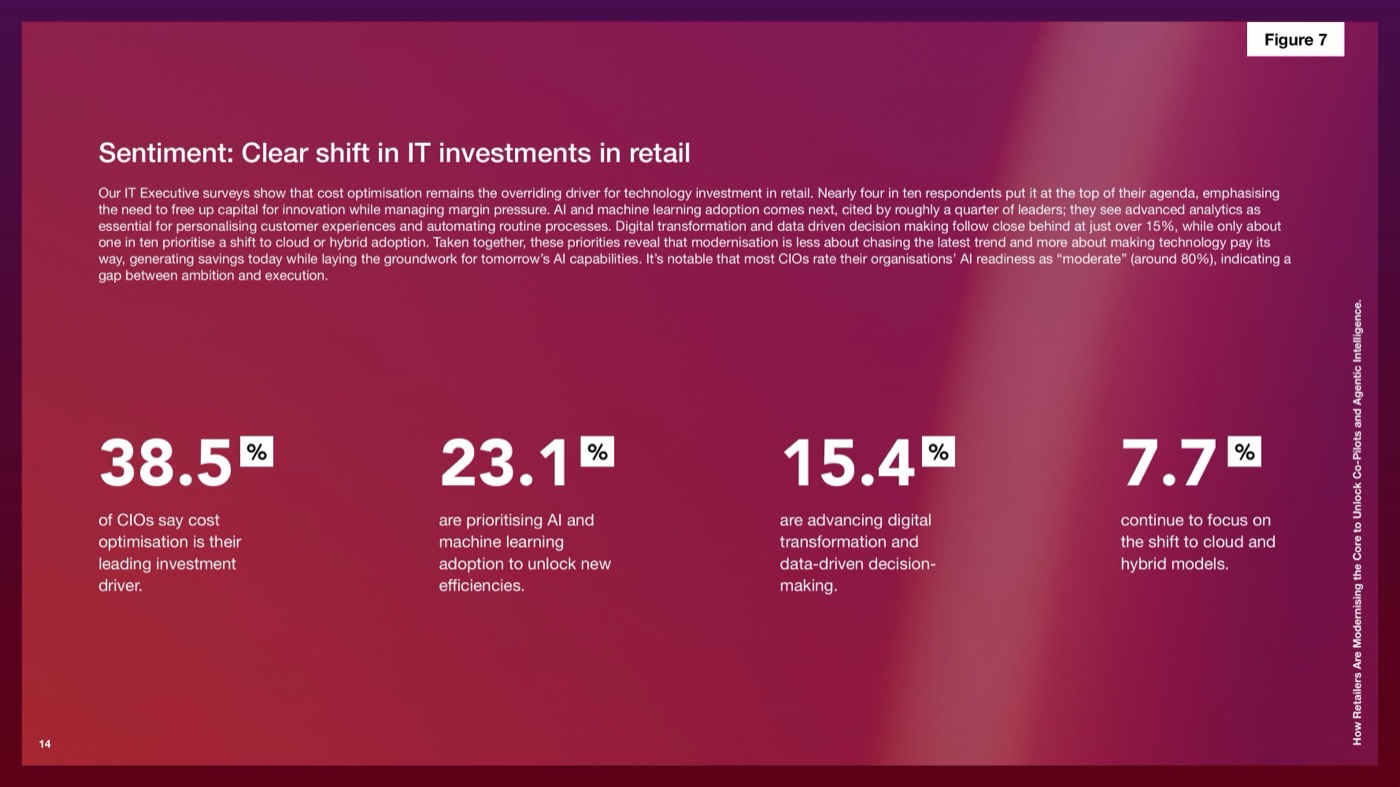
Figure 7: IT investment drivers in retail. 38.5% of CIOs say cost optimisation is their leading driver; 23.1% are prioritising AI and machine learning adoption.
Across all three surveys, a shared aspiration emerges. CFOs speak of cashflow visibility, automation and more time for business partnering; data leaders emphasise trusted, scalable platforms; and CIOs focus on composable architectures that accelerate insights. Yet each group identifies obstacles that cut across functional lines. The way forward is therefore inherently collaborative: aligning roadmaps, establishing joint governance and co-investing in platforms and talent.
The Stakeholders in Retail Share One Ambition
To build a unified, AI-ready foundation that powers real-time decisions. The shift from fragmented systems to connected, intelligent platforms is the breakthrough that will redefine visibility, agility and performance across the enterprise.
Voices from the field: the challenges of modernising the core
Modernising the retail core is not just a technology problem; it involves structural, cultural and operational shifts. In round-table conversations, leaders described five recurring challenges.
- Aging ERP systems and fragmented architectures. Retailers still depend on outdated ERPs and tangled integrations that block real-time visibility and scale. Standbags CTO John Khoury says their back-end systems are "not connected, not modern and not scalable", despite heavy front-end investment.
- Data quality and governance gaps. Poor data undermines decisions and compliance; leaders cite silos, inconsistent definitions and manual pipelines as persistent blockers.
- Cultural resistance and skills shortages. Teams cling to spreadsheets and manual approvals. Grendons Advisory's Luke Brennan says poor data forces "spray and pray" inventory planning, and shortages in data engineering, AI and change management deepen the gap.
- Investment constraints and ROI justification. Modernisation stalls when benefits are unclear; CFOs and CIOs face transformation fatigue and tighter budgets, so success now hinges on proving margin, capital and risk gains.
- Compliance and sustainability pressures. New ESG and privacy mandates demand accurate, auditable data to track emissions, labour and supply-chain metrics while meeting rising cyber-security standards.
The maturity model: from ERP to co-pilots to agentic intelligence
Factor proposes a three-stage model for the AI-enablement journey. Foundational modernisers focus on replacing end-of-life ERP systems, consolidating data platforms and establishing master data governance, with success measured in shortened time to close, automated reconciliations and improved data quality. Accelerators, once the core is unified, deploy AI co-pilots across finance, supply chain and merchandising, from cash-flow forecasting to adaptive demand planning and real-time margin control. Pioneers experiment with agentic AI: systems that autonomously initiate actions based on goals and constraints, including procurement agents that negotiate with suppliers, adaptive pricing engines and self-healing supply chains, while exploring new revenue streams such as data monetisation and retail media networks.
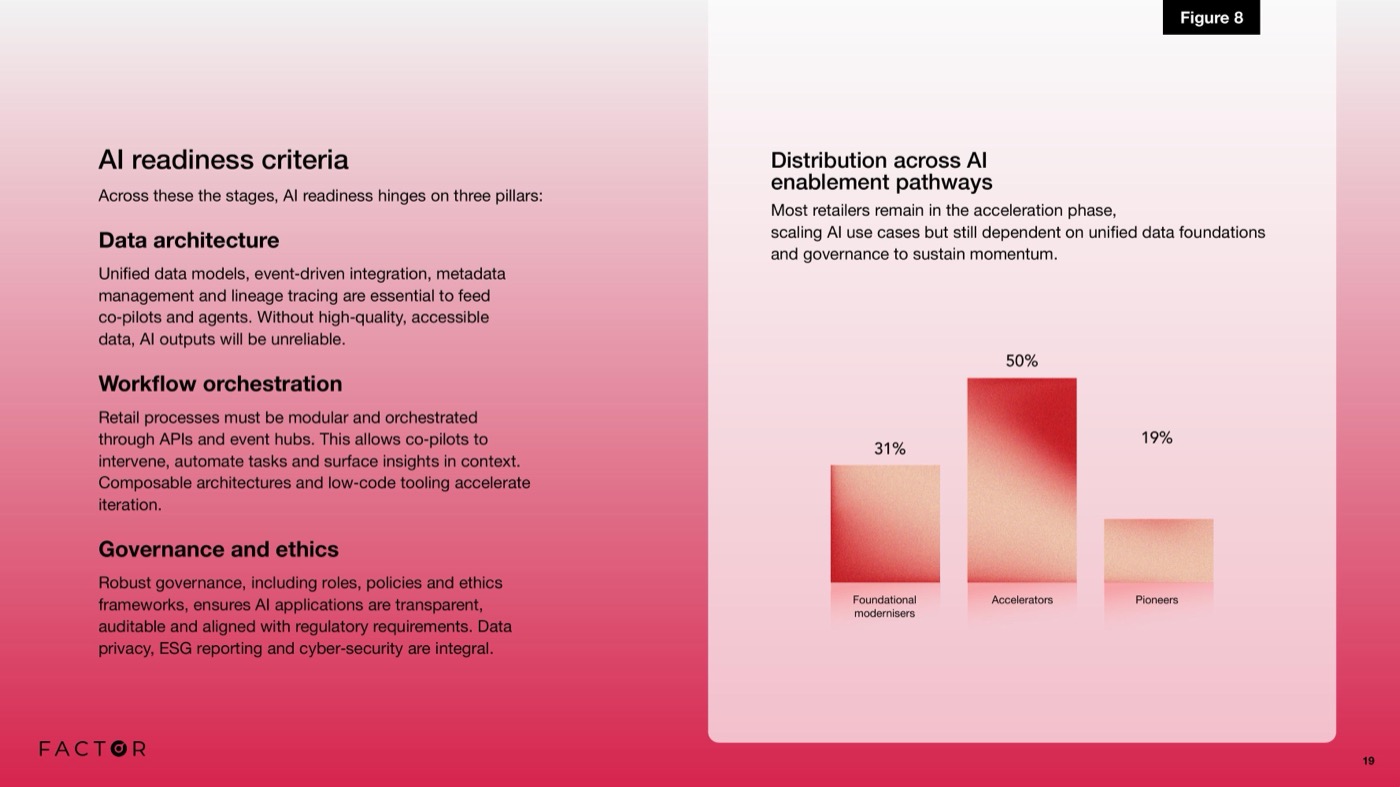
Figure 8: Distribution across AI enablement pathways. Most retailers (50%) sit in the accelerator phase, with 31% still foundational modernisers and 19% pioneers.
Across these stages, AI readiness hinges on three pillars. Data architecture: unified data models, event-driven integration, metadata management and lineage tracing are essential to feed co-pilots and agents; without high-quality, accessible data, AI outputs will be unreliable. Workflow orchestration: processes must be modular and orchestrated through APIs and event hubs, allowing co-pilots to intervene, automate tasks and surface insights in context. Governance and ethics: robust roles, policies and ethics frameworks ensure AI applications are transparent, auditable and aligned with regulatory requirements.
High-impact use cases and commercial value
Modernising the core unlocks a spectrum of AI-enabled use cases, and Factor's research highlights three with measurable ROI. In supply-chain demand planning, accurate forecasting reduces stockouts, markdowns and waste. In the ANZ context, AI models combining historical sales, weather, promotion and mobility data can optimise store-level orders.
Finance co-pilots and cognitive automation are reshaping finance operations through automated invoice matching, anomaly detection, cash-flow forecasting and scenario planning. By reducing manual reconciliations and shortening close cycles, finance teams release capacity for strategic partnering; in Factor's survey, retail CFOs ranked "automation for efficiency" and "cash-flow and working-capital management" among their top priorities. Real-time margin control and dynamic pricing address a third persistent concern: AI can track input costs, competitor actions and demand elasticity, allowing finance and merchandising teams to adjust prices dynamically to protect margins while sustaining growth. Round-table participants noted the ongoing tension between top-line revenue and profitability; dynamic pricing, underpinned by AI-driven scenario analysis, helps reconcile these aims.
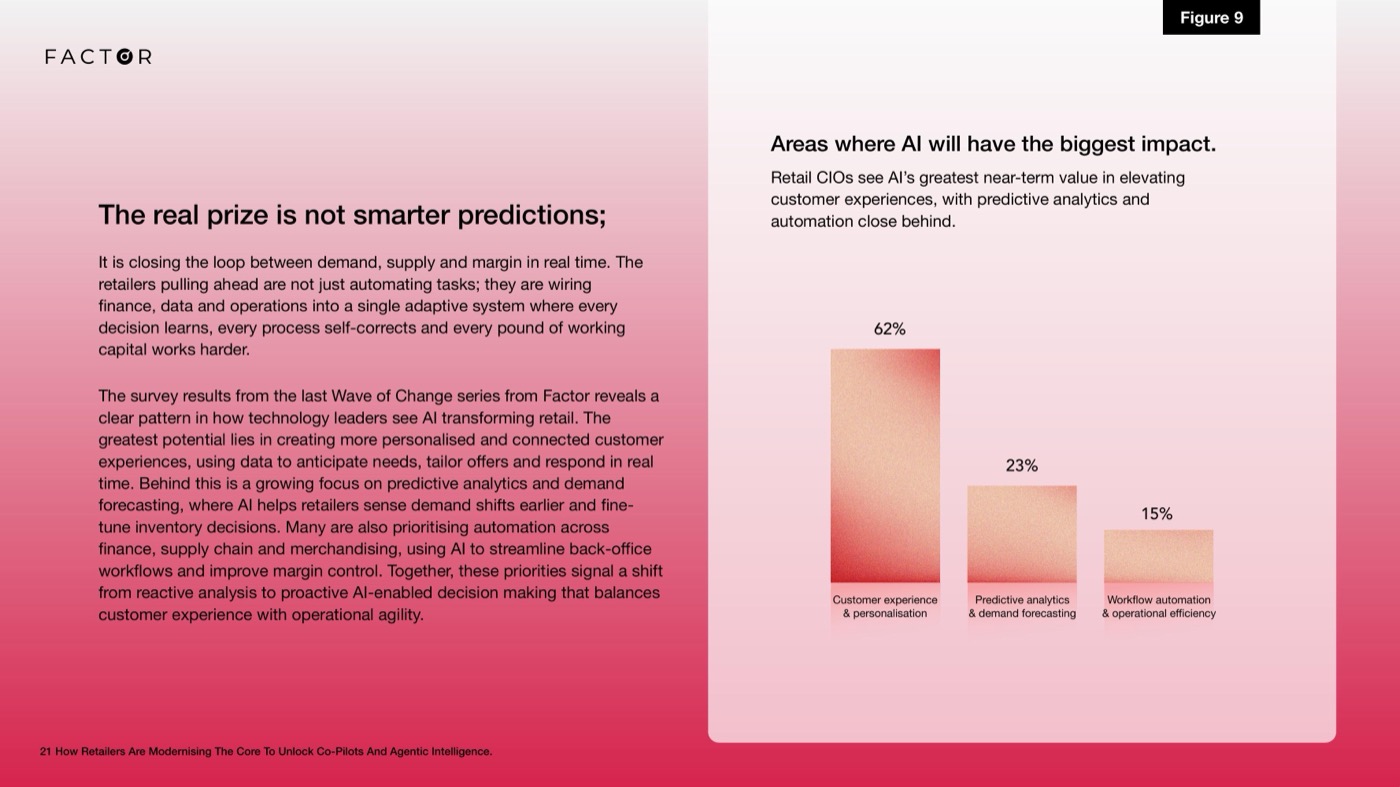
Figure 9: Areas where AI will have the biggest impact. Retail CIOs see the greatest near-term value in customer experience and personalisation (62%).
The real prize is not smarter predictions
It is closing the loop between demand, supply and margin in real time. The retailers pulling ahead are not just automating tasks; they are wiring finance, data and operations into a single adaptive system where every decision learns, every process self-corrects and every pound of working capital works harder.
Data and architecture foundations
Achieving these use cases requires robust technical foundations, and Factor's research shows where ANZ retailers sit on their cloud journey. Despite progress, only around one fifth of finance teams are fully cloud-native. Most (42%) operate in hybrid environments, while about a third have moved the majority of workloads to the cloud and 5% are just starting. Integration maturity tells a similar story: 39% of organisations run a mostly unified middleware layer, 37% still rely on point-to-point integrations, and only 25% have fully integrated real-time flows.
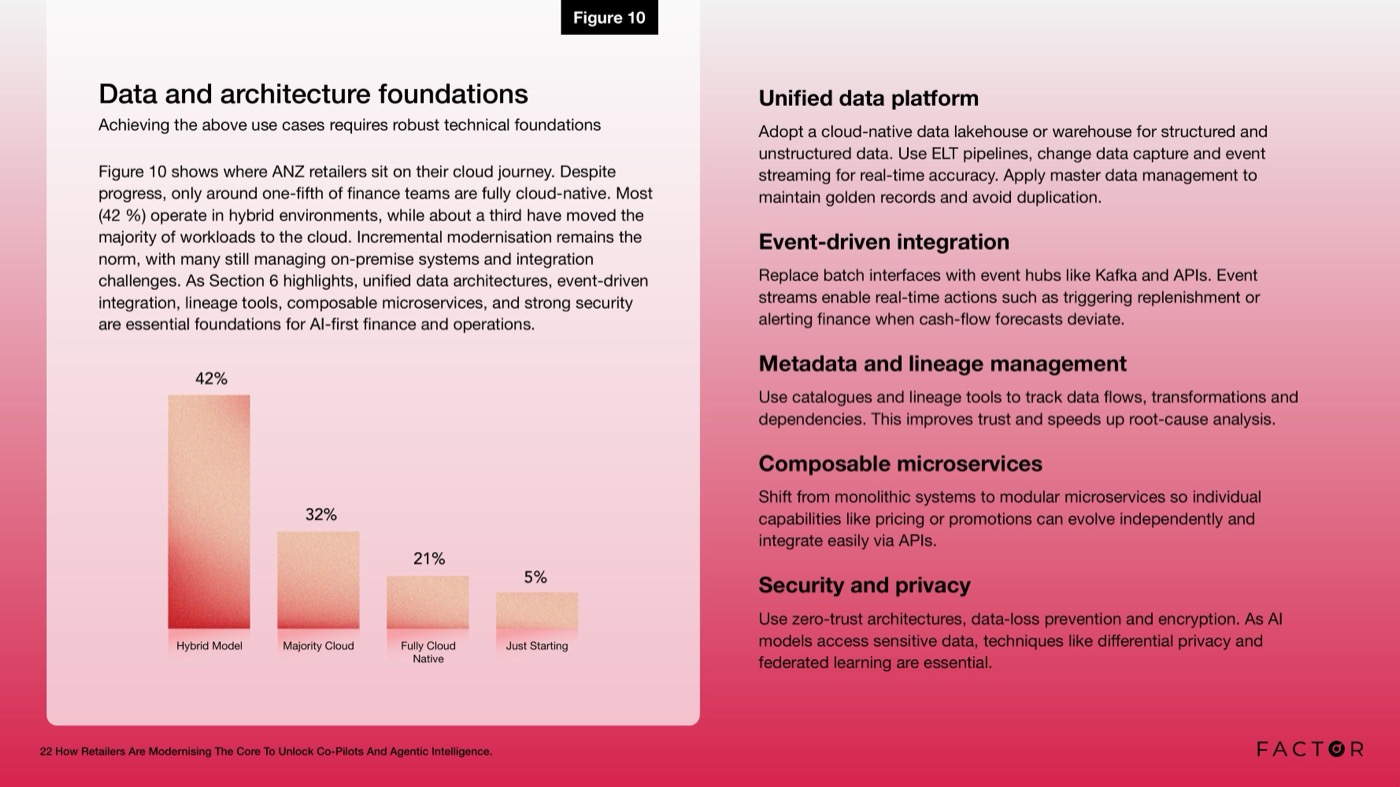
Figure 10: Cloud adoption in ANZ retail finance. 42% operate a hybrid model; only 21% are fully cloud native.
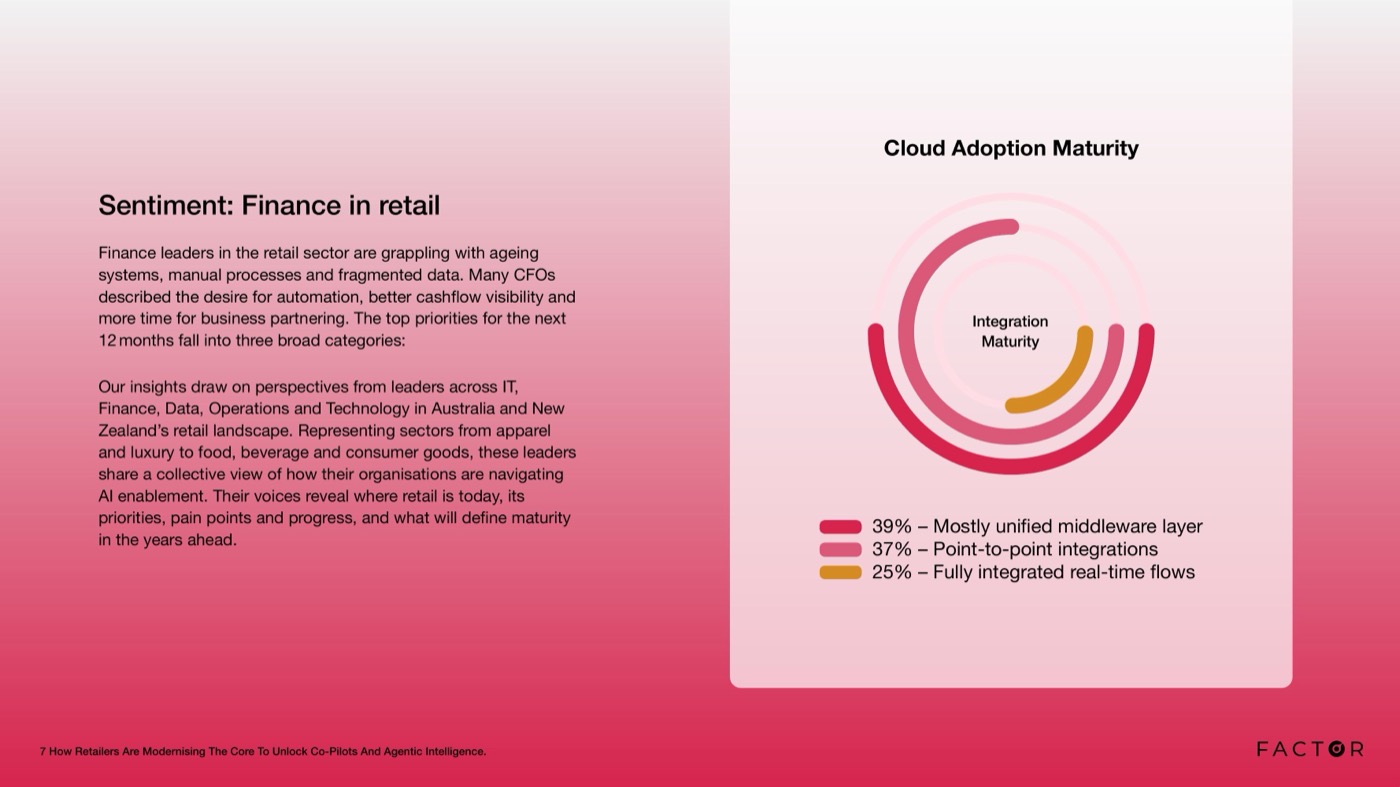
Integration maturity: 39% run a mostly unified middleware layer; only 25% have fully integrated real-time flows.
Factor's research points to five architectural priorities: a unified, cloud-native data platform with ELT pipelines, change data capture and master data management to maintain golden records; event-driven integration that replaces batch interfaces, so event streams can trigger replenishment or alert finance when cash-flow forecasts deviate; metadata and lineage tools that track data flows and speed up root-cause analysis; composable microservices, so capabilities like pricing or promotions can evolve independently; and security and privacy built on zero-trust architectures, data-loss prevention and encryption, with techniques like differential privacy and federated learning as AI models access sensitive data.
Leadership, culture and the pathways forward
Technology alone will not deliver transformation. Leaders should link technical gains to business outcomes, showing how modernisation cuts risk, frees capital and drives growth. Respondents cited resistance to change as a key challenge; culture shifts need empathy, coaching and data literacy. Agile experimentation matters too: 30-, 60- and 90-day cycles, measuring results and adapting. Asked by Factor about essential leadership qualities for today's CFOs, respondents put people-centred leadership and stakeholder engagement (33%) and adaptability and change management (33%) at the top, followed by technology and data fluency (25%), with business partnering and communication and coaching at 10% each.
Building on the maturity model, Factor's analysis outlines three archetypal pathways reflecting different starting positions and risk appetites; retailers may start in one path and transition as capabilities mature. For most, the strategic actions for 2025-26 are to deploy AI co-pilots in priority domains, starting with finance (cash-flow forecasting, scenario planning) and supply chain (demand forecasting, inventory optimisation); to invest in event-driven architecture and orchestration platforms; and to develop AI literacy and ethics frameworks with feedback loops to refine models. Pioneers should pilot agentic systems that can autonomously negotiate procurement contracts, optimise pricing or manage promotions based on high-level goals, monetise data under strict governance, and invest in quantum-resistant security and ethical AI auditing.
To translate strategy into action, Factor recommends six steps: align finance and technology roadmaps around a shared vision; secure leadership sponsorship with a business case that quantifies benefits; establish a data-governance framework with clear ownership and accountability; invest in people and culture, emphasising that technology augments, not replaces, human judgement; design for composability, favouring open APIs and modular services; and experiment with co-pilots through proof-of-concepts in cash-flow forecasting, demand planning and margin control.
To Factor in
ANZ retailers stand at the cusp of an AI-enabled future. The turbulence of 2024 exposed the fragility of legacy systems and galvanised leaders to seek efficiency, resilience and new growth. Consumer expectations for seamless, personalised experiences are rising, while sustainability obligations and cyber-threats demand robust governance. As economic conditions improve from 2025 onward, retailers that modernise their core, embrace AI co-pilots and cultivate data-driven cultures will gain a decisive advantage.
The AI enablement journey is not linear; it requires vision, persistence and collaboration. Finance, technology and data leaders must co-design roadmaps, invest in people and process, and choose technologies that balance quick wins with long-term flexibility. By focusing on data unification, workflow orchestration and governance, retailers can unlock powerful co-pilots today and prepare for agentic intelligence tomorrow. Those that seize this moment will not only survive but thrive in an increasingly digital, AI-first world.
Related insights
The AI-Augmented Marketer
From shifting executive expectations to rising efficiency pressures, this paper offers a practical roadmap for CMOs to modernise marketing, operationalise AI, and build trust-centred, high-impact customer experiences in a competitive B2B landscape.
AI in Australian Finance
Australia’s finance sector is on the verge of significant change
Embracing Change
How CMOs Can Lead the Way in through Disruption