
Research Report
January 15, 2026
CIO - Wave of Change™ ANZ 2026
After two years of rapid AI acceleration, ANZ technology leaders enter 2026 with confidence - but the data reveals a widening set of gaps between ambition and value.

41%
Hybrid environments dominate the base of the stack, with 41% of the leaders Factor surveyed identifying hybrid as their
16%
In Factor's survey, 16% operate SaaS-first models and 14% run multi-cloud environments, with smaller adoption of contain
10%
Above that, Factor's data shows the enablement layer is thin and tactical: API-first approaches (10%) and data analytics
18%
When incidents or slowdowns occur, only 18% of the organisations in Factor's survey report a fully unified, single-pane-
ANZ technology leaders are not short of ambition, and they are not short of investment. What they are short of is control. Factor's July 2026 CIO Wave of Change survey, an extract of the quarterly Tech Decision Maker survey drawing on 102 respondents across Australia and New Zealand, shows an executive cohort whose digital and AI programmes are being slowed not by rare failures or bad strategy, but by the weight of accumulated complexity: platforms layered on platforms, automation bolted onto automation, and data scattered across systems that were never designed to work together.
The survey's core read is blunt. The challenge is no longer selecting the right technologies. It is making accumulated platforms, processes and data work together reliably at scale. Manual effort, siloed data and fragmented integrations, the everyday mechanics of how work gets done, are absorbing value before it reaches outcomes. The shift now underway across the region is a move away from infrastructure expansion and towards simplification, governance and execution certainty: from accumulation to control.
57%
Manual effort is the single largest source of execution drag
43%
Siloed data limits visibility and analytics confidence
41%
Fragmented integrations keep change slow
19%
Fully prepared for expanded AI and analytics demand
18%
Report fully unified visibility across systems
86%
Cite modernisation and platform reset as the biggest strategic rethink
Manual effort, siloed data and fragmented integrations, the everyday mechanics of how work gets done, are absorbing value before it reaches outcomes.
The quotes throughout this analysis are drawn from CIO Day transcript excerpts within the same research programme, and they converge on one message: leaders are describing a control problem, not a tooling problem.
You have to still run the bank while you are transforming the bank. It is two big things happening simultaneously.
- Technology Delivery Director, Tier 1 Global Bank
The stack is not modern or legacy. It is a stack of eras
Asked to describe the real shape of their infrastructure foundation today, respondents painted a picture that is neither modern nor legacy but layered. Hybrid environments dominate the base of the stack, with 41% of the leaders Factor surveyed identifying hybrid as their primary foundation. Cloud-native adoption is meaningful at 25%, but legacy (12%) and on-premise systems (8%) continue to underpin critical workloads. Modernisation is happening around existing platforms, not instead of them.
The cloud and platform layer is being built on top of that base rather than replacing it. In Factor's survey, 16% operate SaaS-first models and 14% run multi-cloud environments, with smaller adoption of containerisation (6%), edge (5%) and serverless (4%). The pattern the survey reveals is expansion driven by application needs rather than a unified architectural strategy.
The cloud... you can scale up and down at will. But the reusability is the biggest component.
- Technology Delivery Director, Tier 1 Global Bank
Above that, Factor's data shows the enablement layer is thin and tactical: API-first approaches (10%) and data analytics and BI (10%) lead adoption, followed by low-code and no-code (7%) and workflow automation (6%). At the top sits an aspirational advanced layer of distributed applications (6%), AI and ML workloads (5%), application performance-led architectures (4%) and high-performance compute (3%). That thin top layer is why AI ambition continues to outpace infrastructure readiness: the capabilities leaders most want to scale are sitting on foundations that were never simplified beneath them.
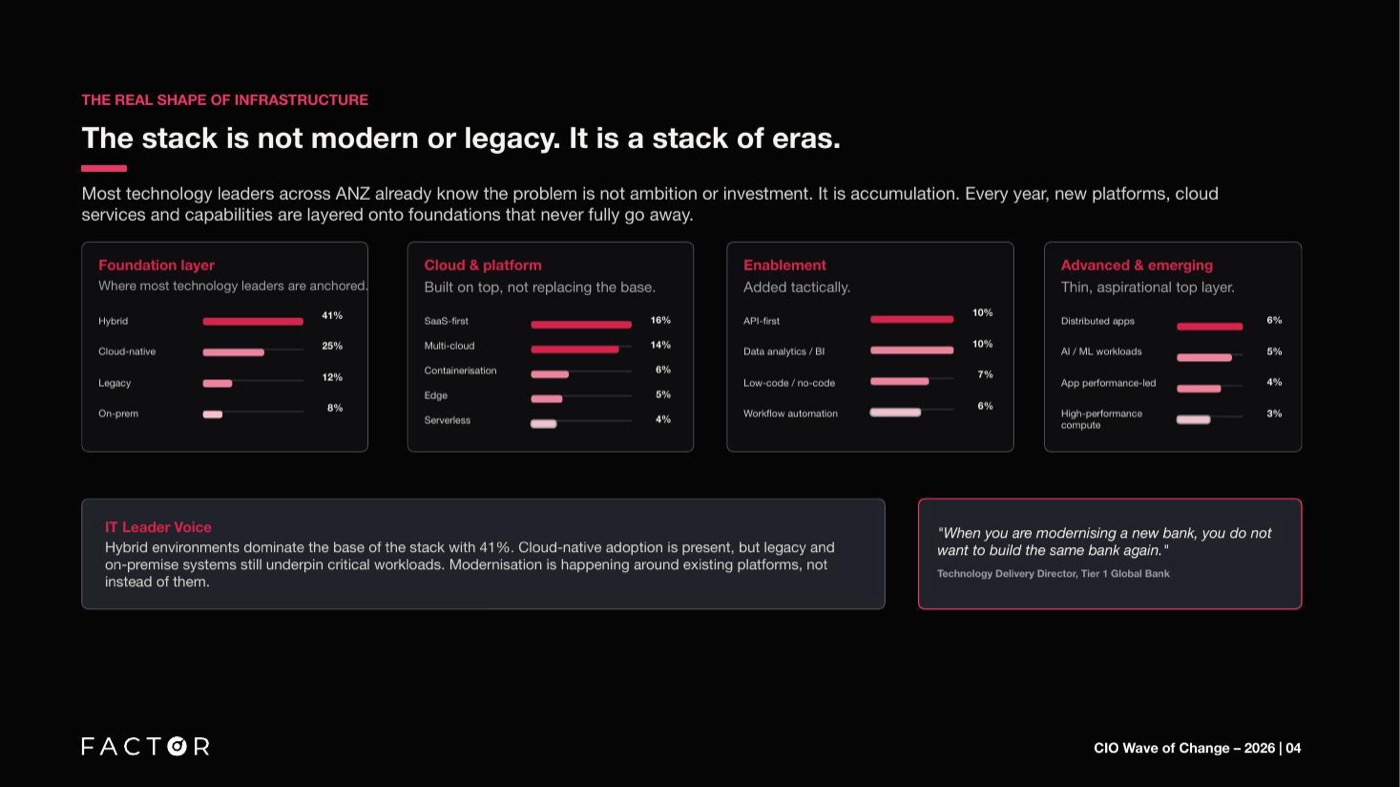
The four-layer stack ANZ technology leaders are actually running: hybrid foundations at 41%, thinning to AI/ML workloads at just 5% in the advanced and emerging layer.
When you are modernising a new bank, you do not want to build the same bank again... You do not want to be building the same thing again on a new platform.
- Technology Delivery Director, Tier 1 Global Bank
Why this matters
Capability is being added without enough simplification beneath it. The operating challenge is coherence: making new and old layers work together with less manual effort, clearer ownership and stronger control.
Over half lack real-time visibility, and releases still depend on hands
When incidents or slowdowns occur, only 18% of the organisations in Factor's survey report a fully unified, single-pane-of-glass view that lets teams see across systems and act quickly. A further 28% describe their environment as mostly unified, with remaining blind spots. The majority operate without full coherence: 34% report a partially unified environment and 20% rely on multiple tools per environment. Put together, over half of ANZ organisations lack consistent, real-time visibility across their infrastructure.
Delivery maturity tells the same story. Only 16% told Factor they run a fully automated software delivery lifecycle, while most operate with integrated CI/CD across key services (32%) or some automated pipelines (35%). A further 16% still rely primarily on manual deployments. DevOps tooling is widespread, but automation is unevenly applied: manual steps and handoffs remain embedded in release processes, limiting deployment speed, increasing operational risk and constraining scalability.
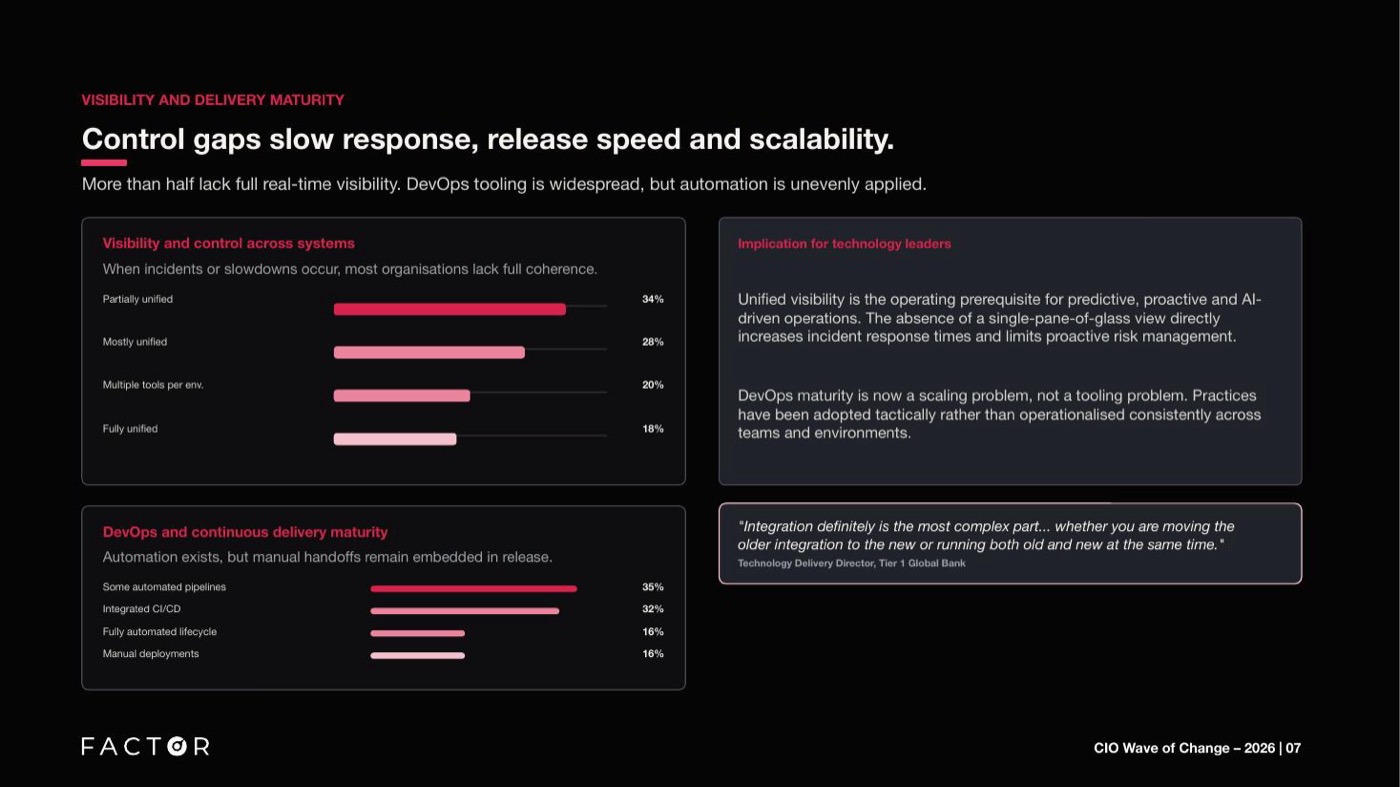
Visibility and DevOps maturity across the region: only 18% report fully unified visibility, and only 16% a fully automated delivery lifecycle.
Why this matters
Unified visibility is the operating prerequisite for predictive, proactive and AI-driven operations. The absence of a single-pane-of-glass view directly increases incident response times and limits proactive risk management. DevOps maturity is now a scaling problem, not a tooling problem: practices have been adopted tactically rather than operationalised consistently across teams and environments.
Integration definitely is the most complex part... whether you are moving the older integration to the new or you are running both old and new at the same time so that you flick the switch when you have moved everything over to the new.
- Technology Delivery Director, Tier 1 Global Bank
AI cannot scale beyond the plumbing it runs on
Data and integration maturity is similarly partial. 41% of respondents told Factor they run some API-driven processes and 35% operate with a central API gateway and strategy, but only 12% have reached full lifecycle API and interoperability management, and another 12% still rely primarily on ad hoc integrations. APIs are recognised as critical, yet governance, reuse and lifecycle management are not yet mature. Leaders consistently signalled that advancing even one level of maturity would unlock disproportionate value, improving data flow, ecosystem connectivity and AI scalability.
That immaturity flows directly into AI readiness. Only 19% of the organisations Factor surveyed consider themselves fully prepared to support expanded AI and analytics demand. The majority are either mostly prepared (32%) or only partially prepared (39%), while 10% say they are not prepared at all. The gap reflects limitations in infrastructure scalability, data pipeline reliability and operational maturity rather than any lack of ambition.
Low-code and no-code, often positioned as the pressure valve for stretched delivery teams, remains early-stage and centrally held. In Factor's survey, 39% report IT-led low-code development and 36% indicate isolated pilots only, while just 15% have achieved scaled citizen development across business units and 10% have no initiatives underway. Its potential to relieve delivery bottlenecks at the business edge remains largely unrealised.
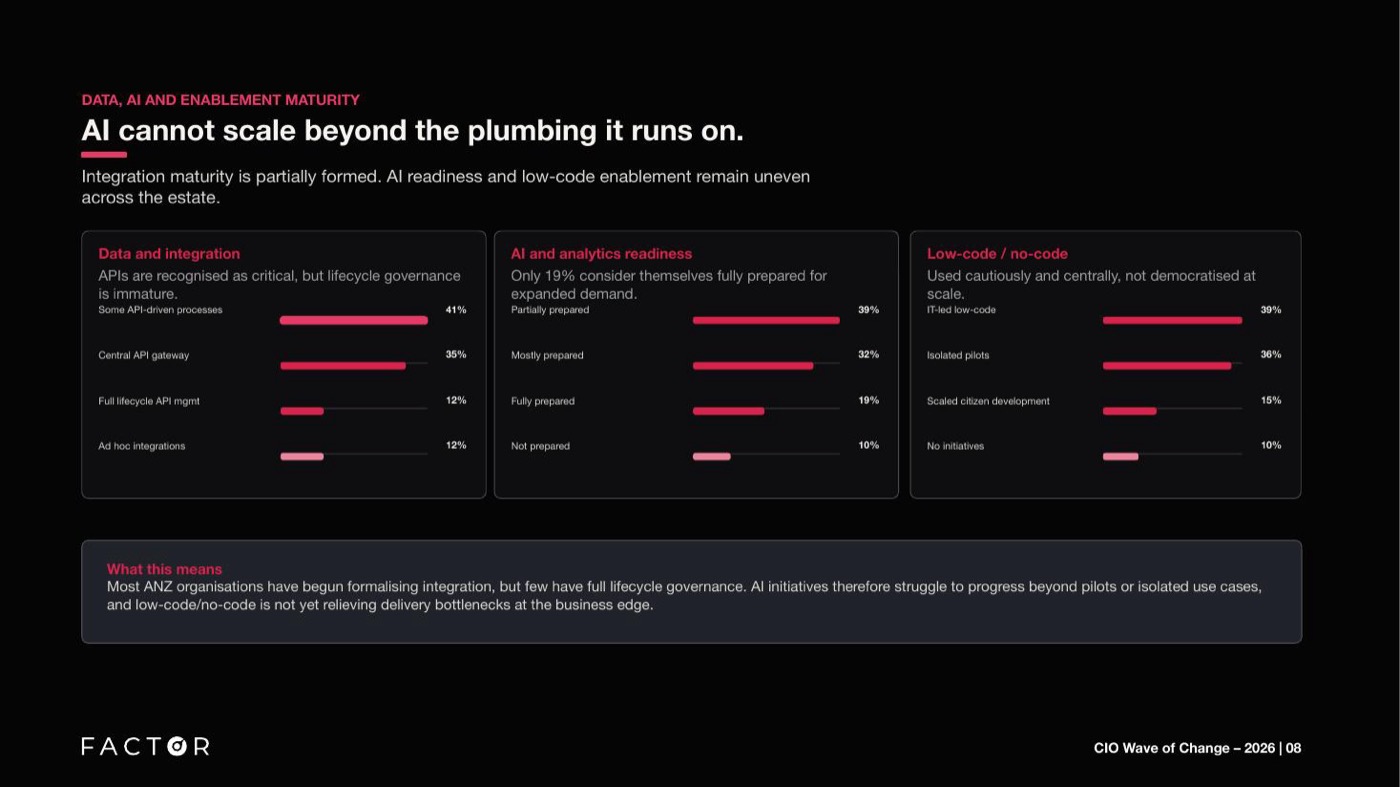
Data and integration, AI and analytics readiness, and low-code maturity: three views of the plumbing beneath ANZ AI ambition.
What this means
Most ANZ organisations have begun formalising integration, but few have full lifecycle governance. AI initiatives therefore struggle to progress beyond pilots or isolated use cases, and low-code and no-code is not yet relieving delivery bottlenecks at the business edge.
Four converging pressures are forcing a hard reset
Leaders across ANZ are no longer setting priorities in isolation. The survey shows them being pushed from incremental optimisation into hard resets across platforms, operating models and capability foundations, driven by four converging structural pressures.
Technology modernisation and platform reset dominates, cited in 86% of mentions in Factor's survey. Application modernisation, cloud migration, ERP renewal and data strategy overhauls are no longer transformation initiatives; they are risk mitigation moves. Legacy platforms are actively constraining scalability, resilience and AI ambition, and modernisation has become the entry price for relevance rather than a future-state aspiration.
Operating model and leadership change influences 53% of responses to Factor's survey, with new CIO appointments, budget resets, workforce restructuring and post-M&A integration disrupting established roadmaps and forcing leaders to re-justify every dollar. AI-driven capability expansion exerts pressure on 42%, as GenAI launches and productivity mandates pull AI forward from experimentation into expectation. The data is clear on the sequencing: AI is accelerating prioritisation rather than defining it, because gaps in data readiness, integration and automation must be addressed before AI can deliver material value. Finally, governance, risk and external pressure affect 30% of prioritisation decisions, with compliance reform, board directives, audit findings and incidents elevating security, resilience and operational visibility from hygiene factors to board-level concerns.
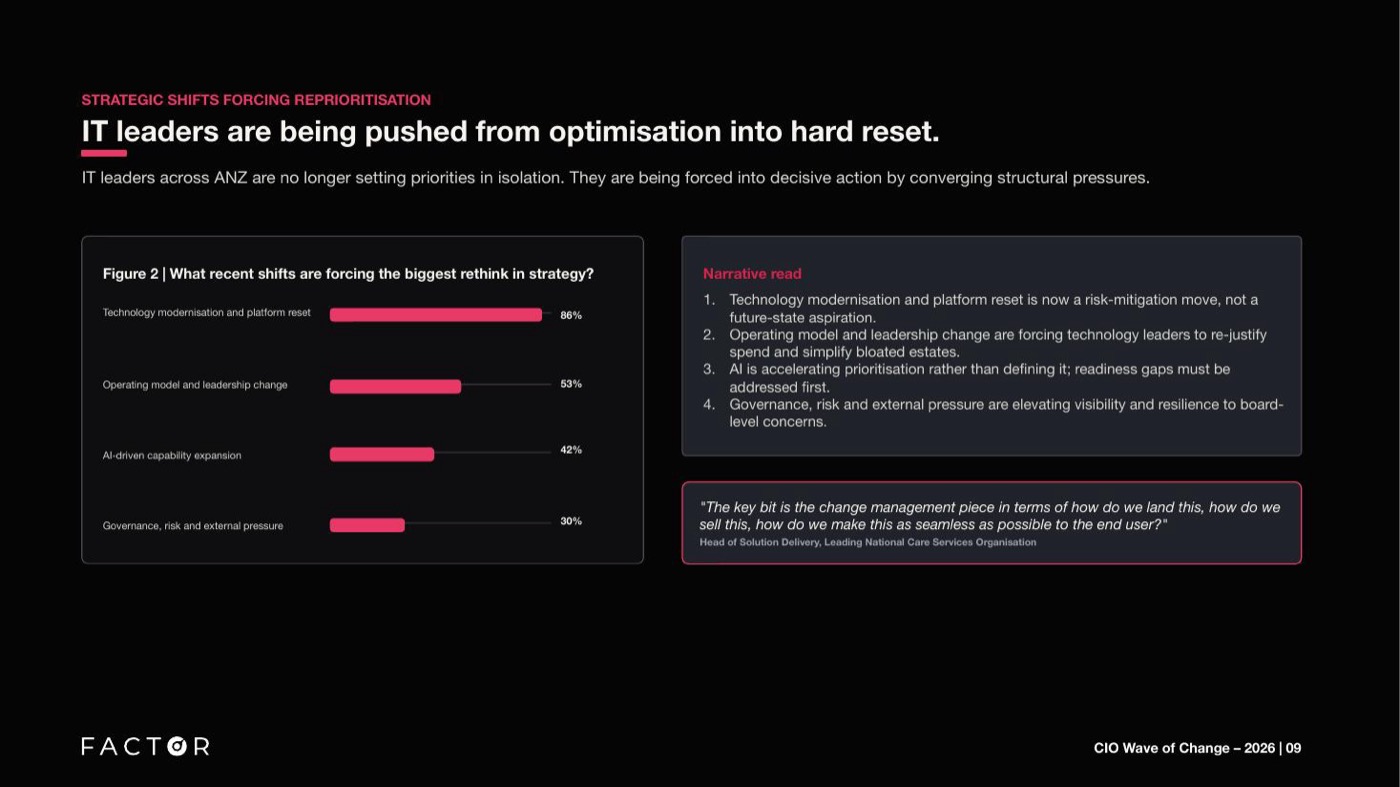
What recent shifts are forcing the biggest rethink in strategy? Technology modernisation and platform reset leads at 86%.
The key bit is the change management piece in terms of how do we land this, how do we sell this, how do we make this as seamless as possible to the end user?
- Head of Solution Delivery, Leading National Care Services Organisation
Automation has become a new source of complexity
Automation was meant to be the antidote to complexity. Instead, the survey shows it has become a new source of friction. It has been added incrementally over time, often in response to immediate pressures, rather than designed as part of a unified operating model. The result is overlapping tools, duplicated capabilities and manual glue code that quietly erode speed, inflate costs and dilute accountability.
Over a third of the leaders Factor surveyed (34%) identify legacy custom scripts as a major drain on time, cost and momentum. These scripts sit at the seams between systems, often undocumented and fragile, making even minor changes slow and risky. Overlap across workflow automation platforms (26%) and workflow orchestration tools (23%) compounds the problem: running multiple tools with similar intent but different governance models creates confusion around ownership, increases integration effort and fragments execution. Further down the stack, DevOps toolchain overlap (19%), job schedulers (14%) and managed file transfer platforms (12%) reinforce the same pattern. Automation accelerates individual steps but slows the end-to-end outcome. It exists, but it does not compound.
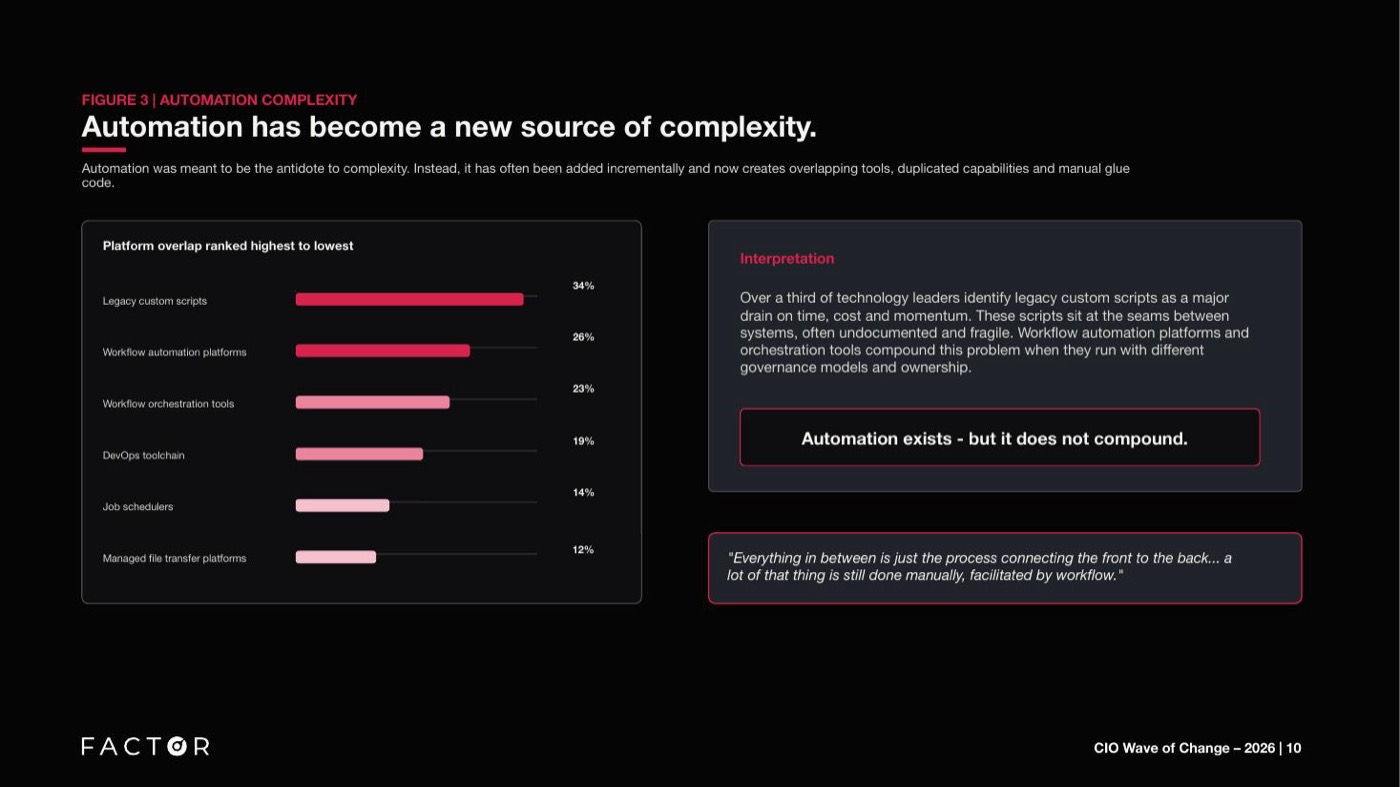
Platform overlap ranked highest to lowest: legacy custom scripts, at 34%, are the biggest drain on time, cost and momentum.
Everything in between is just the process connecting the front to the back... a lot of that thing is still done manually.
- Chief Technology Officer, Top 50 ASX Financial Institution
The biggest drags are everyday mechanics, not rare failures
Asked where friction inside their environment is slowing outcomes they know should be faster, respondents gave Factor a ranking that overturns the assumption that instability is the main threat to delivery. Downtime and instability sit at the very bottom of the table at 3%, alongside incident overload (3%) and audit complexity (5%). The top of the table is dominated by the mechanics of how work gets done: manual effort (57%), siloed data (43%) and fragmented integrations (41%).
Behind those three sit skills gaps (29%), rework and errors (27%), legacy system lock-in (25%), shadow IT (24%), vendor sprawl (23%), security risks (22%) and compliance burden (17%), with long deployment cycles and inconsistent APIs at 11% each and customisation overhead at 8%. Factor's survey groups this friction into three structural bands.
- Process and execution friction: manual effort, rework and long deployment cycles show that work still relies on people instead of flow.
- Architecture and integration friction: siloed data, fragmented integrations and legacy lock-in show that speed is constrained by structure, not effort.
- Capability and operating model friction: skills gaps, vendor sprawl and shadow IT show that complexity is outpacing governance and capability.
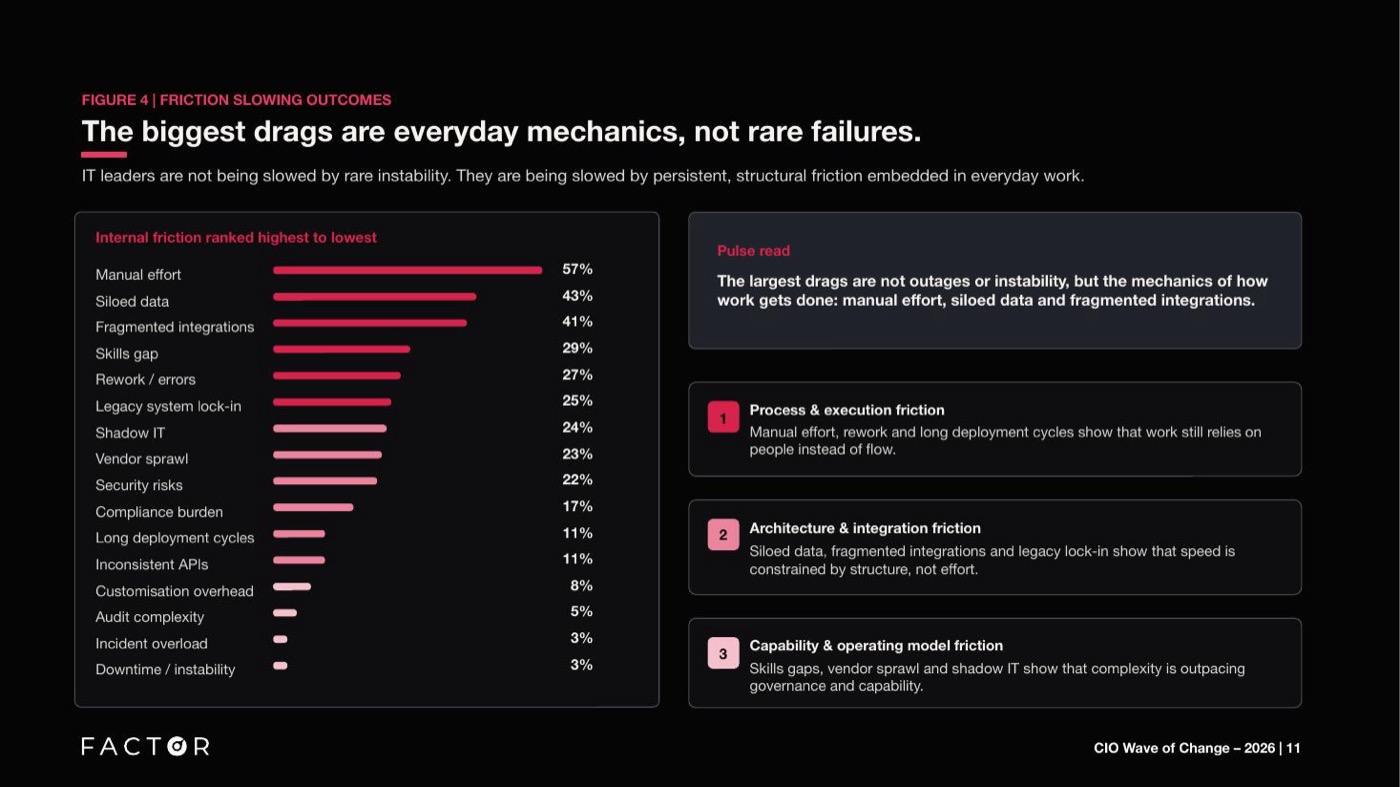
Internal friction ranked highest to lowest: manual effort tops the table at 57%, while downtime and instability sit last at 3%.
The messy middle is absorbing value before it reaches outcomes
This friction explains the question that sits over every ANZ technology budget: why digital and AI investment is not converting into outcomes fast enough. The survey's answer is that the issue is not strategy failure. It is execution leakage. Value is being absorbed in the messy middle, the integration layers, legacy constraints, governance overhead and capability gaps that sit between investment and measurable impact.
Three forces drive the leakage. In Factor's data, messy-middle execution friction dominates: manual effort (57%), siloed data (43%) and fragmented integrations (41%) point to structural breaks across architecture and workflows, where automation exists but rarely end-to-end and platforms coexist rather than compound. Risk, governance and cost pressures amplify the drag: security exposure (22%), compliance burden (17%) and high cost and TCO (26%) are symptoms of fragmented estates, while limited cross-system visibility (only 18% report unified oversight) forces additional control layers. And capability constraints limit recovery: skills gaps (29%), shadow IT growth (24%) and uneven AI readiness (only 19% fully prepared) show platform sophistication outpacing workforce alignment. The downstream effect is slower delivery, localised AI impact and inconsistent value.
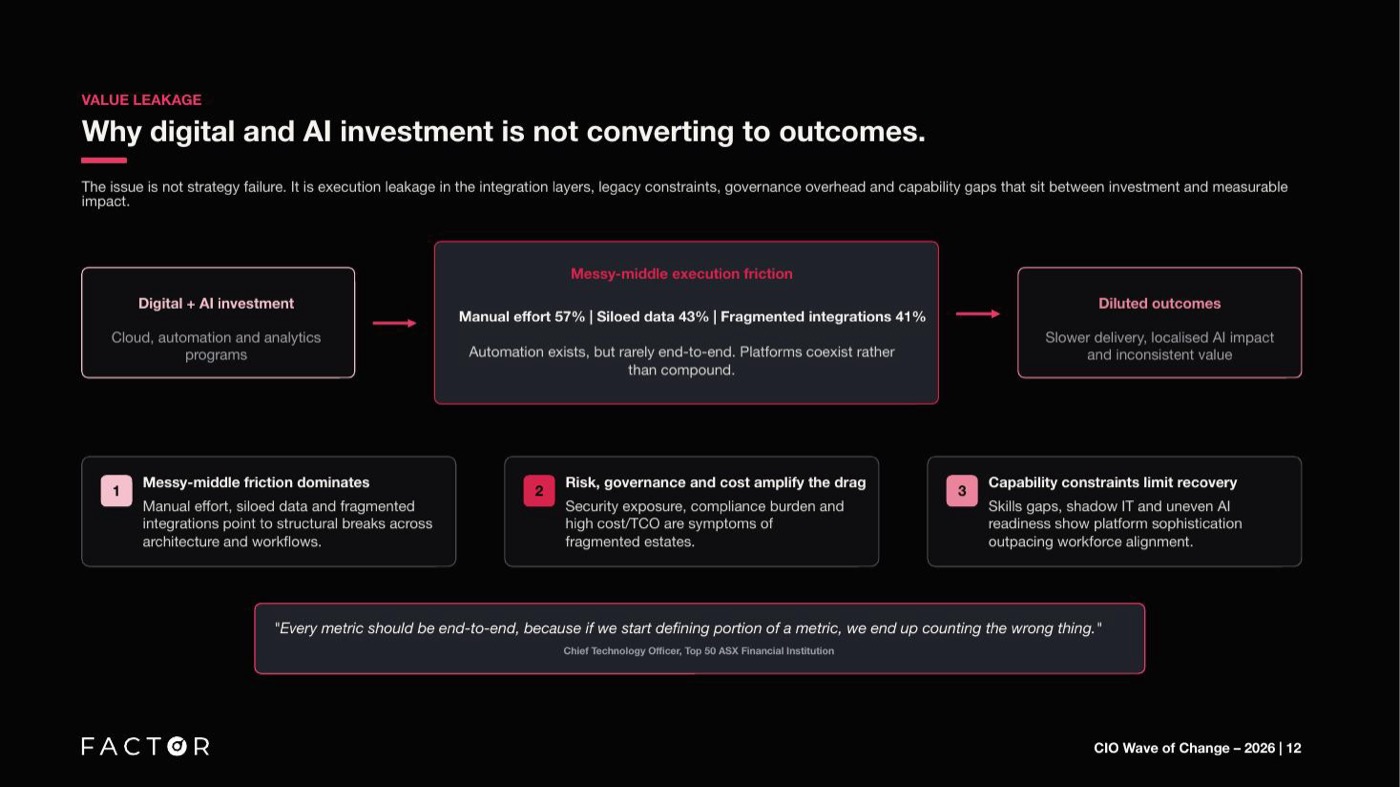
The value leakage chain: digital and AI investment enters the messy middle of execution friction and emerges as diluted outcomes.
Every metric should be end-to-end, because if we start defining portion of a metric, we end up counting the wrong thing, and then that steers us towards the incorrect direction.
- Chief Technology Officer, Top 50 ASX Financial Institution
Why this matters
Digital underperformance is rarely a technology selection issue. It is a systems coherence issue. The next phase of leadership will not be defined by adding new platforms, but by eliminating friction between the ones already in place.
The vendor bar is now operational leverage
Leaders turned the same lens on their suppliers, and the verdict is uncomfortable. Just 7% of respondents told Factor that vendors are meeting expectations. Dissatisfaction is most acute where platforms become barriers rather than enablers of progress: 26% find current solutions too complex or fragmented, 26% cite high cost and total cost of ownership, and 20% each point to poor support and service, lack of roadmap innovation and missing critical integrations. A further 15% say vendor offerings are misaligned to current priorities, and 7% report platforms that cannot scale.
Notably, leaders are not asking for more functionality. They point to excessive complexity, rising costs, limited integration and insufficient execution support. Out of that dissatisfaction, Factor's survey distils a five-part bar that platforms now have to clear.
- Simplify the estate: reduce tool overlap, custom scripts and operating complexity rather than adding another layer to govern.
- Integrate by default: improve visibility and data flow across hybrid environments with native integration and clear orchestration paths.
- Prove ROI under scrutiny: show measurable value through speed, resilience, lower cost to serve and reduced manual effort.
- Support execution: offer proactive service and practical guidance in complex environments where delayed support affects outcomes.
- Keep the roadmap real: advance AI, automation and analytics capabilities in ways that map directly to current priorities.
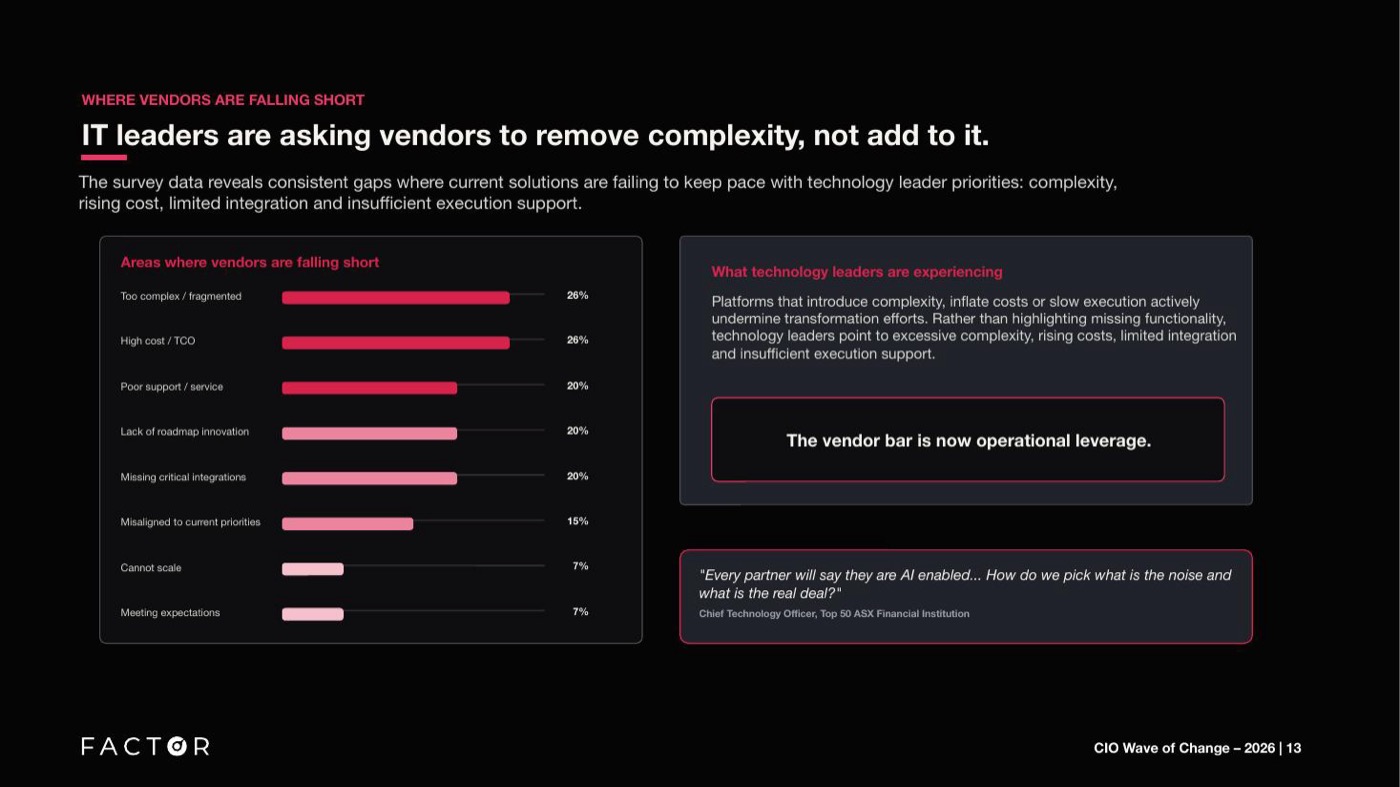
Where vendors are falling short: complexity and cost lead at 26% each, and only 7% of leaders say vendors are meeting expectations.
Every partner will say they are AI enabled... How do we pick what is the noise and what is the real deal?
- Chief Technology Officer, Top 50 ASX Financial Institution
The executive implication
The winning platforms will not be the ones with the most features. They will be the ones that help technology leaders make accumulated complexity disappear.
From accumulation to control
The survey results make one thing clear: ANZ technology leaders are not constrained by lack of ambition or investment, but by the weight of accumulated complexity. Years of layering new platforms, automation tools and cloud services onto foundations that never fully disappear have created environments that are difficult to see, hard to govern and slow to change. Execution, not innovation, now dominates the technology agenda.
What this signals is a decisive shift in priorities. The next phase of technology leadership in ANZ will be defined by simplification, consolidation and execution certainty. Success will come not from adding more capability but from removing friction. On the survey's evidence, the leaders who win will do five things.
- Unify visibility across hybrid and legacy systems.
- Reduce manual handoffs and cognitive load.
- Govern integration and data so AI can scale.
- Modernise the core without adding new layers of complexity.
- Make complexity disappear and deliver outcomes consistently, not just promise them.
Once we have got the whole new ERP in place, consolidation of systems in place... we can truly start to look at moving ahead or looking forward as opposed to catering for the ERP now.
- Head of Solution Delivery, Leading Care Services Organisation
The full CIO Wave of Change report carries the complete data tables behind every chart on this page, the maturity overview across six infrastructure areas, and the vendor shortfall analysis in detail. It is the July 2026 extract of Factor's quarterly Tech Decision Maker survey, based on 102 respondents across Australia and New Zealand.
Related insights
CMO - Wave of Change™ August 2026
ANZ marketing leaders are under growing pressure to prove commercial impact.
CIO - Wave of Change™ Singapore 2025
Shedding light on how technology leaders are adapting to rising complexity
CISO - Wave of Change™ March 2025
The shifting priorities and persistent challenges faced by cybersecurity leaders in Australia.