
Research Report
June 2025
CIO - Wave of Change™ Singapore 2025
Shedding light on how technology leaders are adapting to rising complexity

70%
Cyber security, risk and compliance, operational challenges spanning cost, resilience, vendors and applications, and sca
63%
Growth and ROI, covering revenue and customer experience, was rated highly significant by 63% of the CIOs Factor surveye
77%
Asked which business objectives most impact ICT spending, the CIOs in Factor's survey put growth and ROI first at 77%, f
49%
Cost optimisation dominates as the factor influencing spending over the next year, cited by 49% of Factor's respondents,
Factor's May 2025 Wave of Change survey of 100 Singaporean CIOs found three challenge areas tied at the very top of the agenda. Cyber security, risk and compliance, operational challenges spanning cost, resilience, vendors and applications, and scalability and innovation were each rated highly significant by 70% of respondents. Growth and ROI remains the strongest influence on ICT spending at 77%, yet the problems leaders are actually managing day to day are led by security, governance, cost and resilience.
The research is an extract from Factor's quarterly tech decision maker survey, run as a pulse survey of 100 CIOs across Singapore. It identifies their challenges, strategic priorities, investment opportunities and digital focus areas, offering a view into where these leaders are investing, what is holding them back, and how they are navigating a complex operating landscape to drive sustainable growth.
70%
Rate cyber security, risk and compliance a highly significant challenge
64%
Cite AI/ML as the technology shaping ICT strategy
49%
Name cost optimisation the top market trend influencing spend over the next year
57%
Say integration complexity is the biggest barrier to scaling ICT
20%
Of organisations are genuinely data driven
7%
Are fully cloud native
The picture is not one dominant problem but six live ones, with only sustainability clearly de-prioritised relative to the rest.
Three challenges tied at the top
The challenge heatmap in Factor's survey shows an unusually crowded summit. Cyber security, risk and compliance, a cluster that covers both cybersecurity and sovereignty, was rated highly significant by 70% of CIOs. Operational challenges covering cost, resilience, vendors and applications also landed at 70%. So did scalability and innovation, which spans adoption, integration, AI/ML and ERP. As the report puts it, Singapore's IT leaders identify cyber security, operational resilience and digital scalability as their most pressing challenges, with nearly 70% rating these areas as highly significant.
The next tier is close behind. Growth and ROI, covering revenue and customer experience, was rated highly significant by 63% of the CIOs Factor surveyed. Workforce and skills, spanning skills, staff, mobility and hybrid work, sits at 61%, and cloud and infrastructure, covering cloud access, multi-cloud and skills, at 59%. Sustainability, framed as ESG and Green IT, trails the field at 43%. The picture is not one dominant problem but six live ones, with only sustainability clearly de-prioritised relative to the rest.
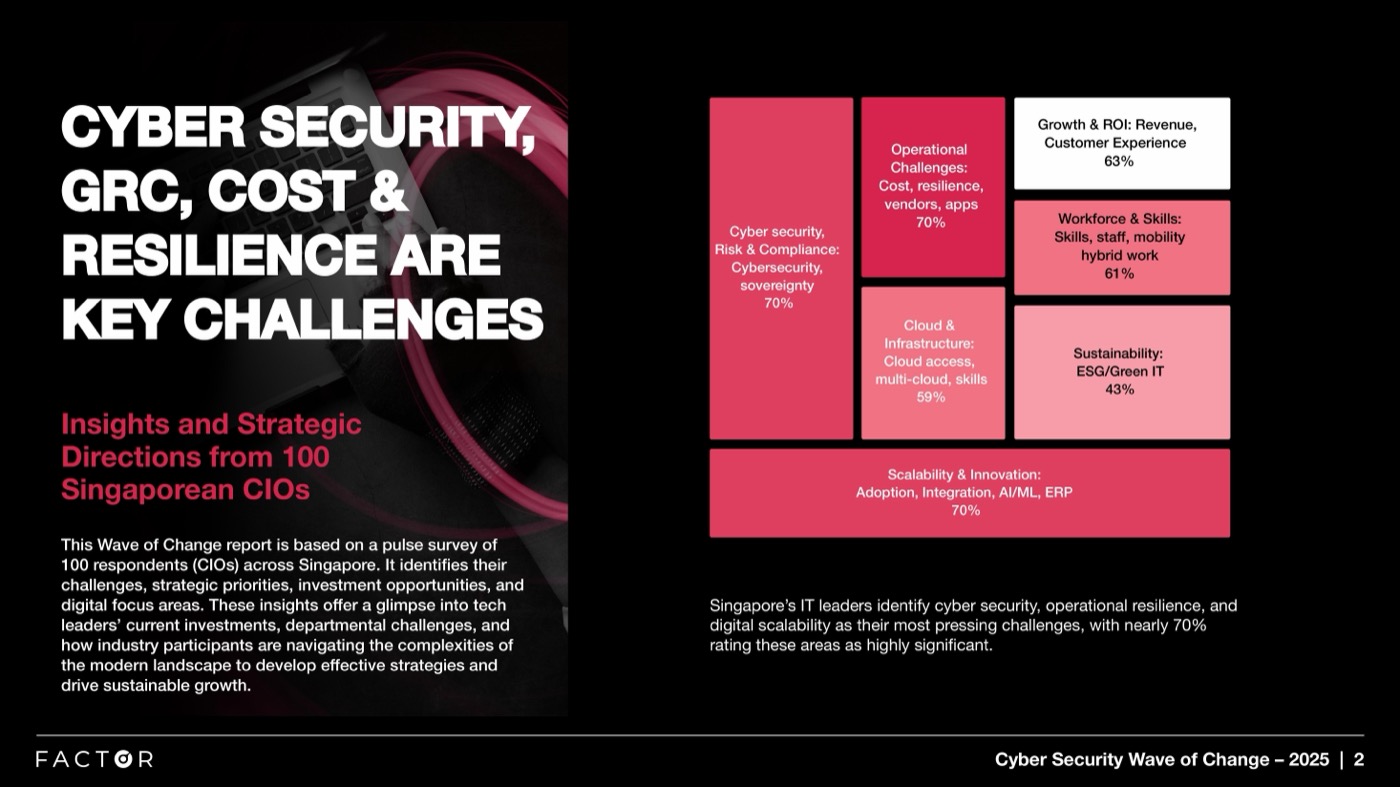
The challenge heatmap: cyber security, operational challenges and scalability each rated highly significant by 70% of Singaporean CIOs.
Growth funds the budget, cost discipline directs it
Asked which business objectives most impact ICT spending, the CIOs in Factor's survey put growth and ROI first at 77%, followed by data and technology at 75%. Efficiency and productivity and risk and compliance tie at 73%. A clear gap then opens before corporate responsibility at 57%, customer and market at 53%, and employee retention and development at 48%. The budget case in Singapore is built on growth and data, with efficiency and risk close behind.
The market-trend view of the year ahead is more lopsided. Cost optimisation dominates as the factor influencing spending over the next year, cited by 49% of Factor's respondents, well ahead of digital transformation initiatives at 20%, growth in AI and machine learning applications at 13%, and demand for data-driven decision-making at 11%. Increased focus on cybersecurity registered just 7%.
That last figure deserves a second look. The same respondents who rated cyber security a 70% challenge told Factor it sits last among the market trends steering next year's spend, at 7%. Security dominates the risk register while cost optimisation dominates the cheque book, which suggests security investment in Singapore has to be argued in cost and outcome terms rather than expected to fund itself on threat awareness alone.
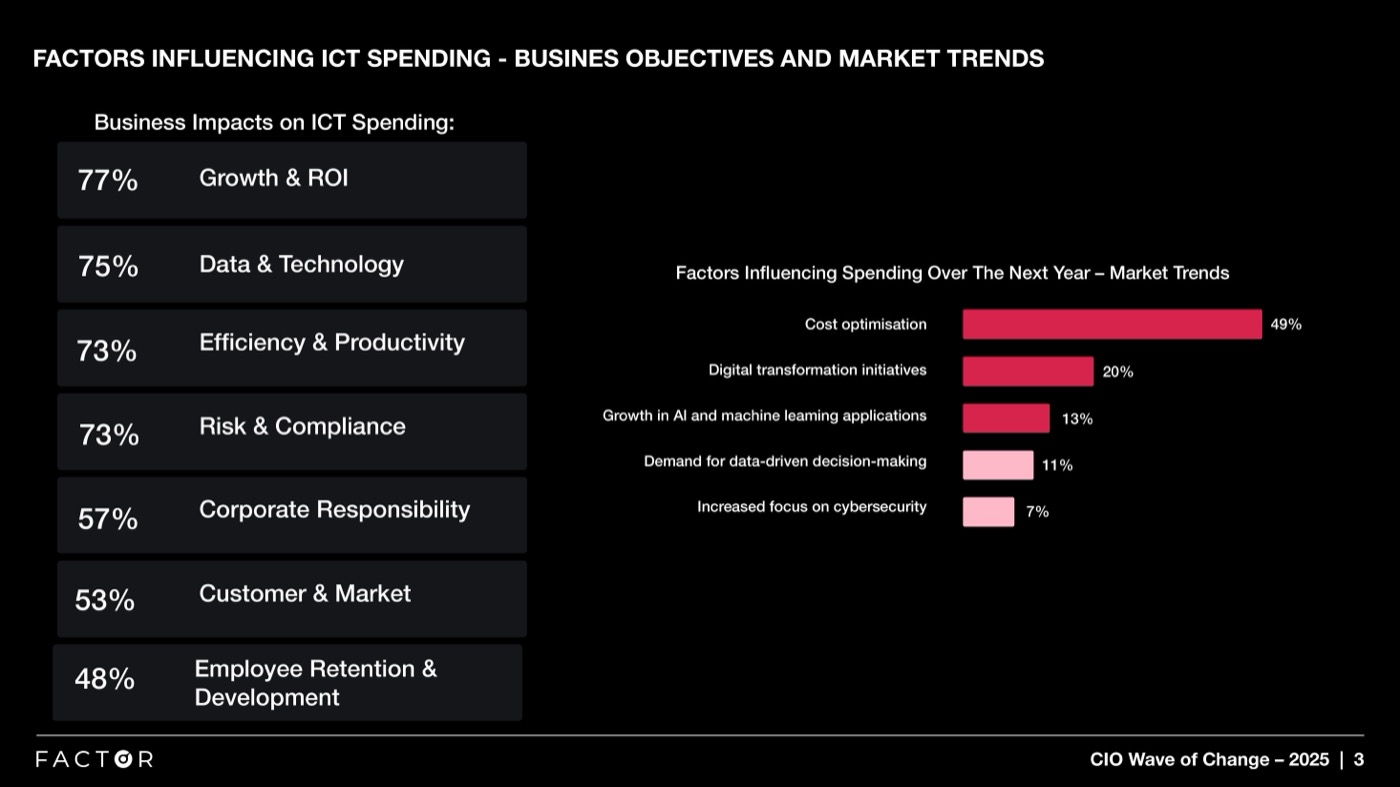
Business impacts on ICT spending, led by growth and ROI at 77%, alongside the market trends shaping next-year spend, led by cost optimisation at 49%.
AI/ML dominates strategic technology direction
When Factor asked CIOs to name the technologies shaping ICT strategy over the next year, AI/ML came in at 64%, four times the next answer. Big data and analytics followed at 16%, cloud-based platforms at 11%, blockchain at 5% and Internet of Things at 4%. The report reads this overwhelming prioritisation as a shift from AI being a futuristic concept to a mission-critical capability.
Factor's survey also maps where leaders see AI making the most impact. Customer experience leads at 22.5%, with AI deployed in personalisation engines, intelligent chatbots and automated support systems. Operational efficiency follows at 22%, as organisations use AI to automate repetitive tasks, streamline internal processes and reduce operational costs. Data and insights sits at 17.4%, with AI-driven analytics supporting predictive modelling and AI-assisted business intelligence. Cyber security accounts for 14.2%, where AI plays a growing role in threat detection, anomaly detection and real-time response, particularly in large, decentralised IT environments.
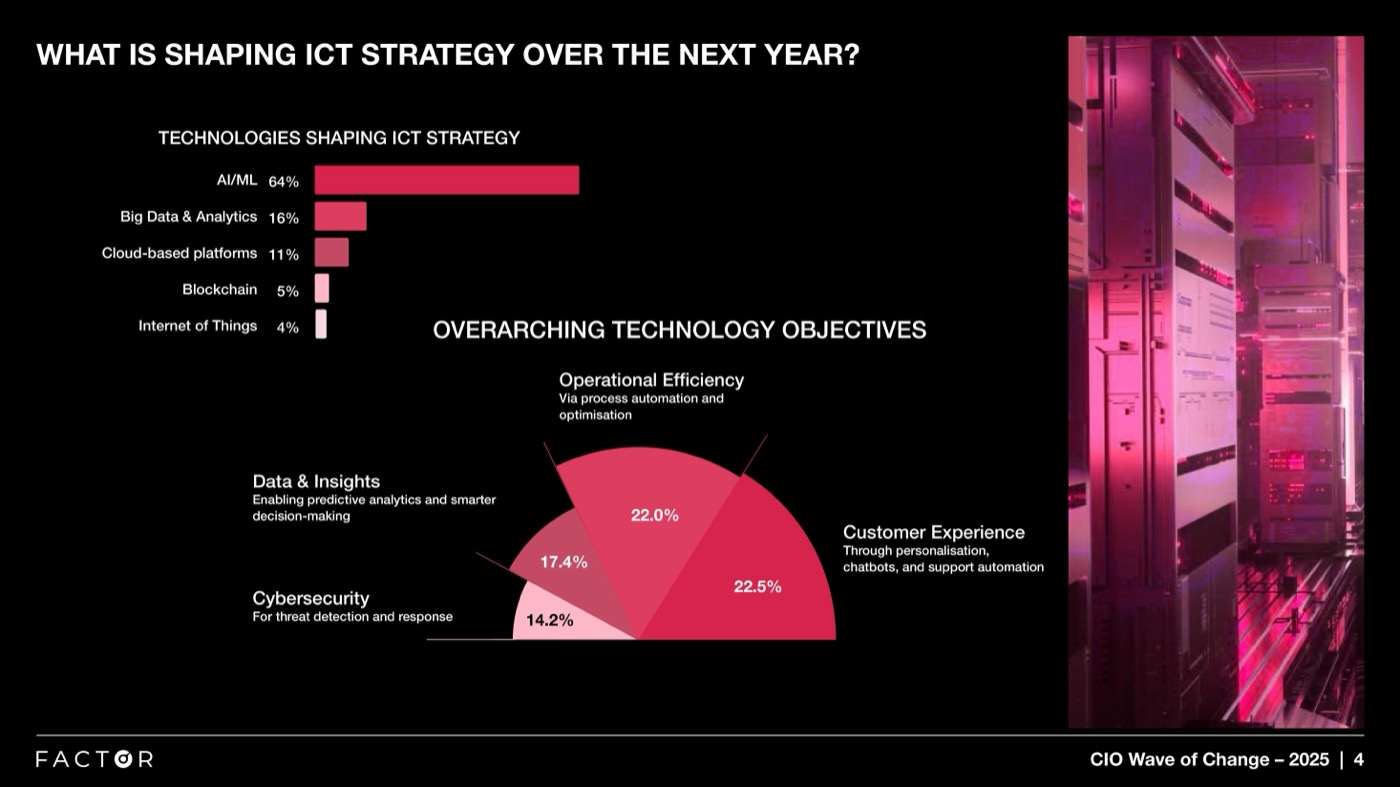
AI/ML leads the technologies shaping ICT strategy at 64%, with customer experience, operational efficiency, data and cybersecurity the main objectives.
Data maturity has not caught up with data ambition
For all the strategic weight placed on AI and analytics, data insight adoption remains nascent. Factor's research classifies 47% of organisations as data-aware, using data regularly but not exclusively in decision-making. Another 33% are data-adjacent, still relying on traditional decision-making but beginning to shift towards data-driven approaches. Only 20% are data driven, where IT leaders base most of their decisions on data insights.
Why this matters
80% of organisations have not yet fully embedded data into their core decision-making processes. Many use data regularly or are starting to explore data-driven strategies while still working through manual processes and fragmented data. Closing the gap between data-aware and data-driven presents a major opportunity.
Cloud ambitions exist but full adoption lags
Singapore's IT leaders are working in hybrid environments, managing a delicate balance between legacy systems and cloud adoption, with almost equal amounts of workload distributed between on-premise and cloud platforms. At the extremes, 15% told Factor they still operate entirely on-premises, possibly reflecting a reliance on legacy systems or regulatory challenges, while only 7% are fully cloud native. Full migration remains rare, and most organisations are managing the complexity of hybrid operations.
Why this matters
The result is a complex hybrid IT architecture that demands integrated management, robust security, and strategic workload placement.
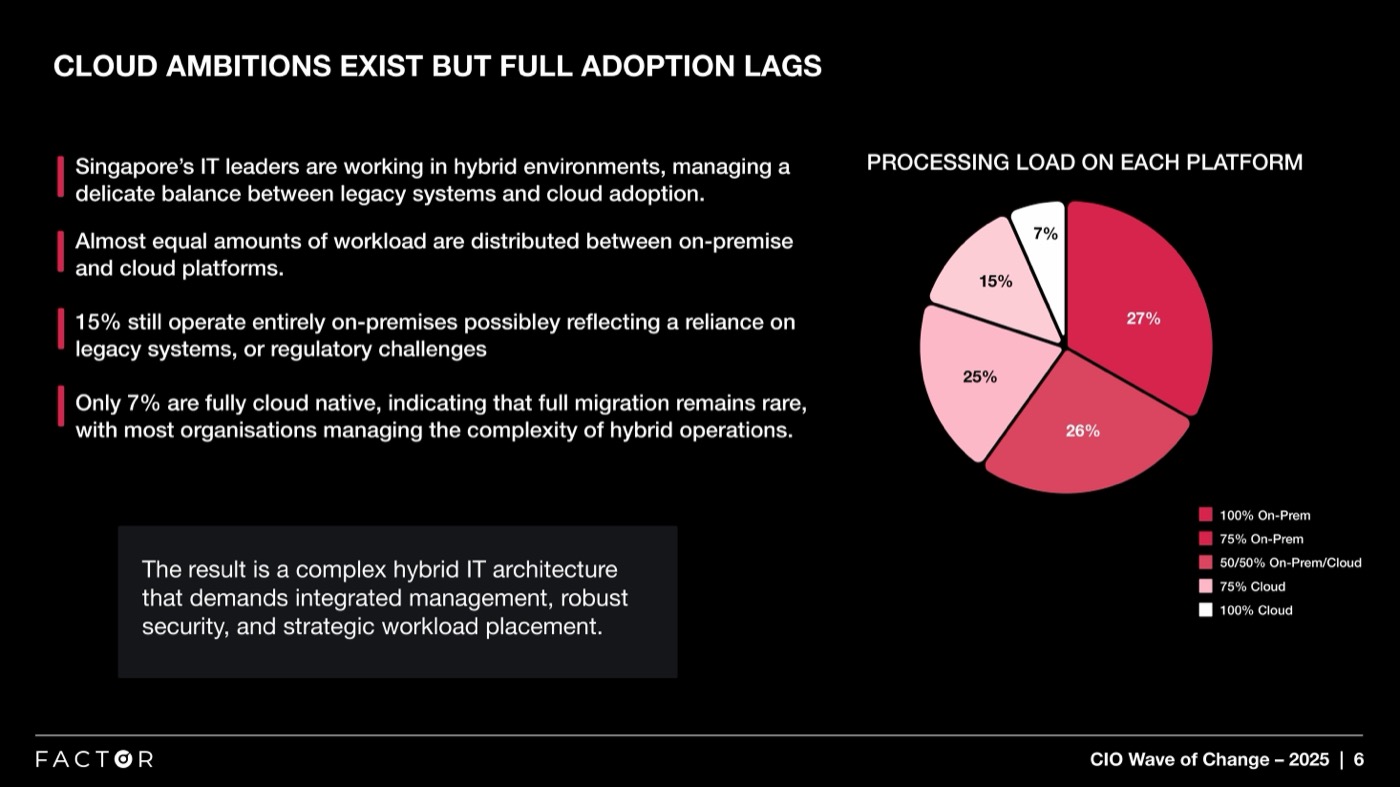
Processing load by platform: workloads sit almost evenly across on-premise and cloud, with only 7% fully cloud native and 15% entirely on-premises.
Integration complexity is the barrier that matters
Asked what is holding back their ICT initiatives, the CIOs in Factor's survey gave a strikingly concentrated answer. Integration complexity is the most significant barrier to scaling, cited by 57%. Insufficient budget follows at 30%, which the report reads as IT leaders contending with competing internal priorities. Talent shortages rank a distant third at 9% but still represent a real concern.
- Integration complexity - 57%
- Insufficient budget - 30%
- Talent shortages - 9%
- Regulatory and compliance - 4%
Factor's report highlights one result as particularly interesting: regulatory and compliance constraints are seen as the least significant barrier, at just 4%. Combined with the hybrid-cloud picture, the message is that the hard part of scaling in Singapore is not permission but plumbing: making a sprawling estate of legacy systems, cloud platforms and applications work together.
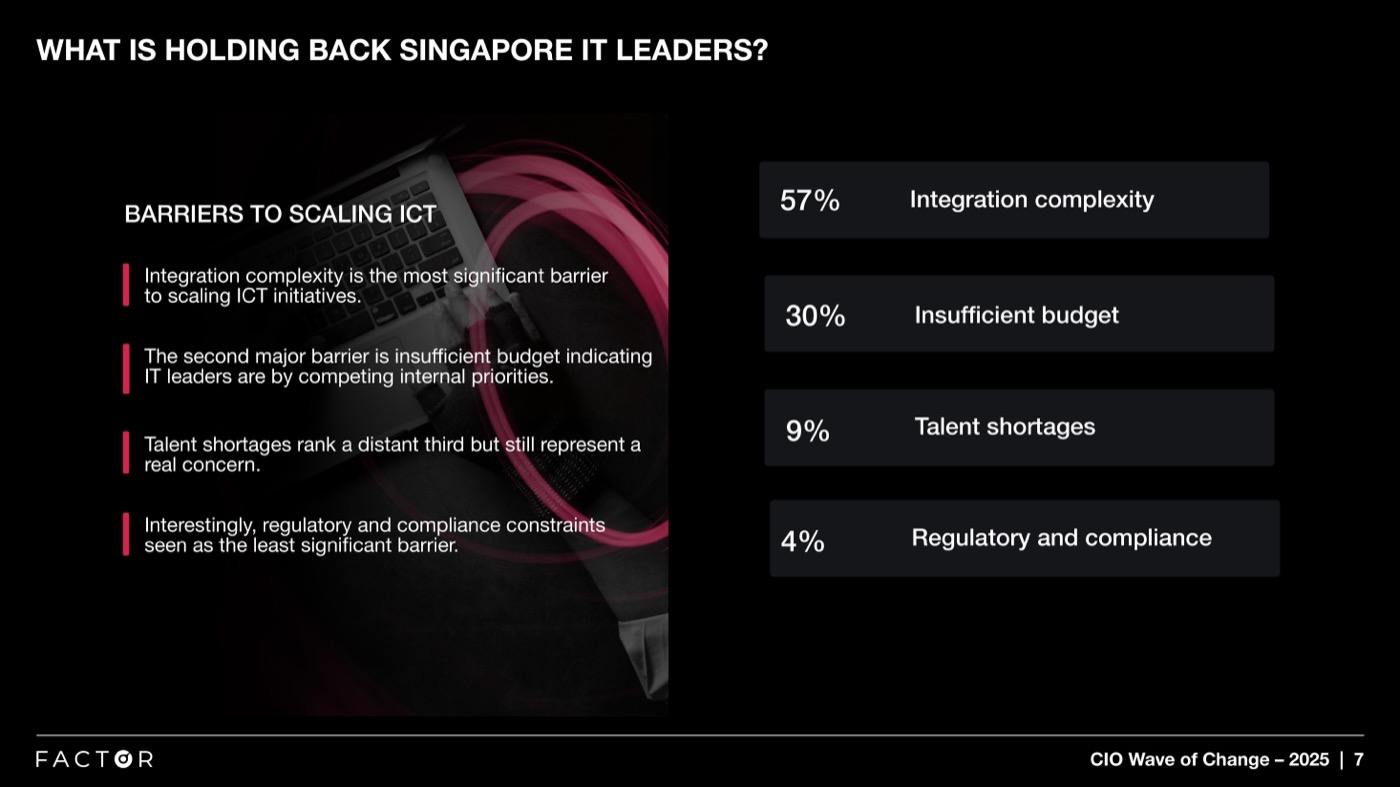
Barriers to scaling ICT: integration complexity dwarfs budget, talent and regulatory constraints.
Security first, value second: what CIOs want from providers
When evaluating new technology solutions, respondents told Factor, advanced security features dominate the criteria at 42%, followed by cost-effectiveness at 23% and comprehensive support and services at 13%. The remaining criteria, including scalability, high-performance metrics, user-friendliness, customisability and industry-specific solutions, each registered in single digits. The report's conclusion: Singaporean IT leaders place the greatest weight on security and value delivery, a reflection of both rising cyber risk and budget-conscious ICT planning, and Singapore's ICT leaders are looking for partners, not just providers.
Who signs off matters too. In Factor's survey, chief executive officers and presidents lead as decision makers or influencers on tech decisions at 40.7%, ahead of chief, head or GM of IT at 22%. On adoption posture, 41% of organisations profile as challengers and 37% as early adopters, with 17% laggards and only 4% leaders.
Why this matters
The data reflects a top-down approach to ICT investment in Singapore, where strategic decision-making is increasingly concentrated with CEOs and senior IT leaders. This underscores the need for technology providers and partners to frame offerings in terms of business outcomes, risk mitigation, and executive value, not just technical specs.
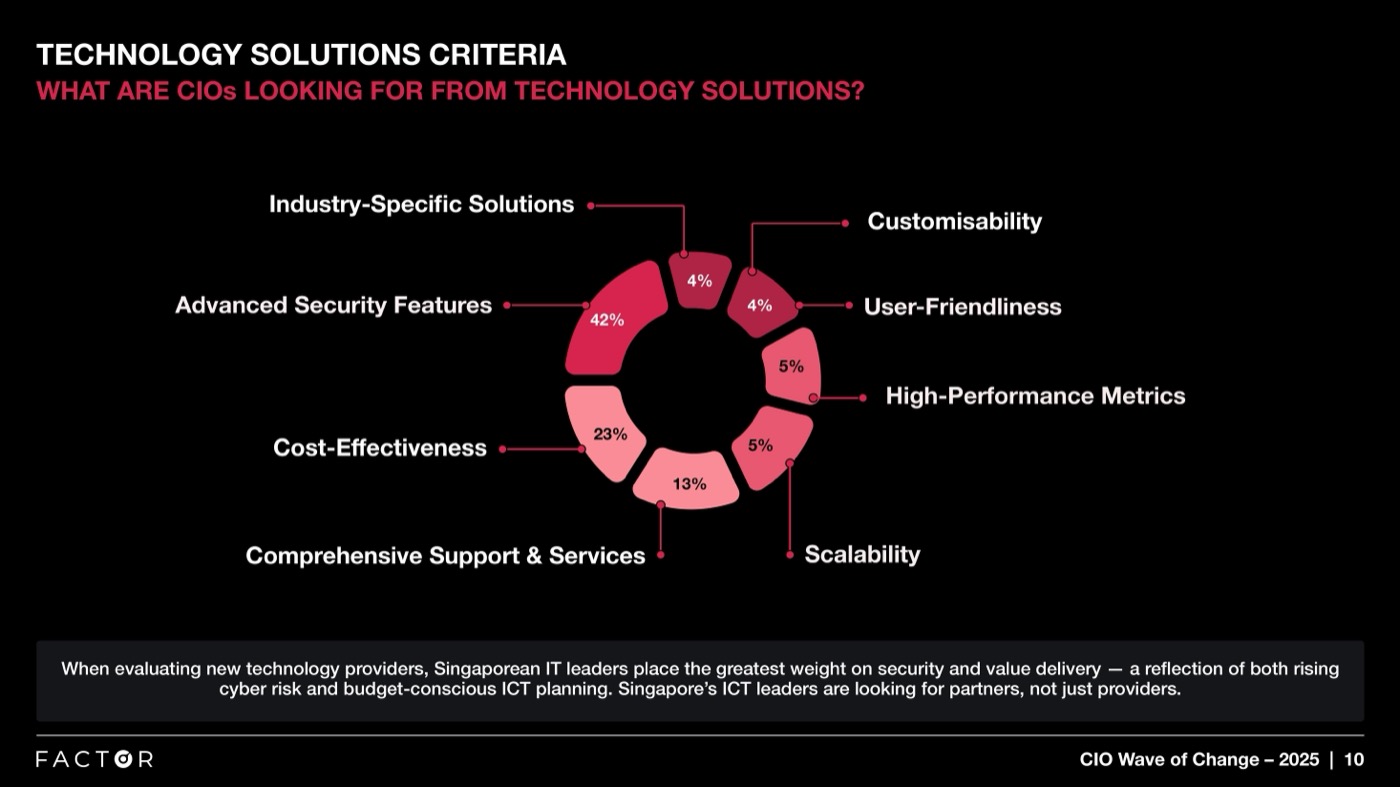
Technology solutions criteria: advanced security features lead at 42%, with cost-effectiveness at 23% and comprehensive support and services at 13%.
Winning the CIO: what the data says works
Factor's report closes with a 20-point playbook for engaging Singaporean CIOs, organised across five themes: core mandate, buying behaviour, messaging, spend areas and the total strategy. The through-line is that technology must drive revenue, not just cost savings, and that every decision must align with security posture. The most actionable points:
- More than 60% of CIOs prefer insights over pitches: vendors must act as trusted advisors.
- Consolidation sells. CIOs do not want 15 tools for the same problem; the question is whether you can replace 3-4 tools.
- Time-to-value matters. In the report's words, if it takes 12 months to deploy, it is already dead in the water.
- Expect long sales cycles: ROI, integration ease and user adoption need proving early, and CFOs and CEOs need financial justification, so sell beyond IT.
- Cyber threats are a top boardroom concern: risk reduction sells, and helping the CIO build a board-level business case gets deals through.
- Speak the language of outcomes, not features, benchmark against peers using unbiased research, and bring proof points showing how others have succeeded.
Taken together, Factor's May 2025 wave sketches a CIO community under simultaneous pressure on security, operations and scale, betting heavily on AI/ML while four in five organisations have yet to fully embed data in decision-making, and asking partners to lead with security, outcomes and simplification rather than features.
Related insights
CMO - Wave of Change™ August 2026
ANZ marketing leaders are under growing pressure to prove commercial impact.
CIO - Wave of Change™ ANZ 2026
After two years of rapid AI acceleration, ANZ technology leaders enter 2026 with confidence - but the data reveals a widening set of gaps between ambition and value.
CISO - Wave of Change™ March 2025
The shifting priorities and persistent challenges faced by cybersecurity leaders in Australia.